Serotonin Is Made in the Gut: Rethinking Mood at Its Source
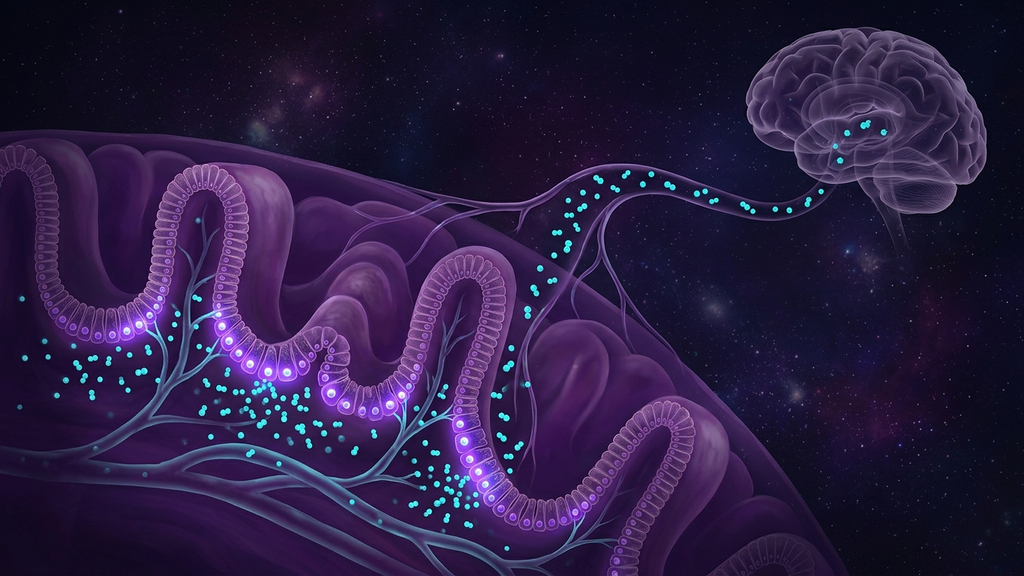
There is a fact that most medical curricula bury in a footnote, but which fundamentally rewires how a clinician should think about depression, anxiety, IBS, and the relationship between the gut and the brain: somewhere between 90 and 95 percent of the serotonin in the human body is produced in the gut. Not in the brain. In specialized enterochromaffin cells in the lining of the small intestine.
The neurotransmitter most commonly framed as a brain chemical is in fact, by volume, a gut hormone.
The Two Serotonin Pools
The body maintains two largely separate serotonin pools. The gut pool, produced by enterochromaffin cells, regulates intestinal motility, secretion, and visceral sensation. It also circulates in the bloodstream bound to platelets, where it participates in vasoconstriction and hemostasis. The brain pool, produced by neurons of the raphe nuclei, is what most people mean when they say "serotonin" — the mood, sleep, and appetite signal.
The two pools are separated by the blood-brain barrier. Peripheral serotonin does not cross. That is the source of considerable clinical confusion: an SSRI does not raise gut serotonin, and gut serotonin does not directly raise mood. But the two systems talk to each other through several elegant indirect channels — and that conversation is where the clinical leverage actually lives.
How the Gut Talks to the Brain About Serotonin
The gut influences mood through at least four pathways that intersect with the serotonin system:
- Tryptophan economy. Both gut and brain serotonin are made from tryptophan, an essential amino acid. The gut microbiome competes with the host for tryptophan and can divert it down inflammatory pathways (kynurenine) instead of serotonergic ones. A dysbiotic gut effectively starves the brain of its serotonin precursor.
- Vagal afferents. Enterochromaffin cells release serotonin onto the vagus nerve, which carries the signal directly to the brainstem. This is one of the fastest gut-to-brain communications in the body.
- Microbial metabolites. Short-chain fatty acids produced by colonic bacteria modulate enterochromaffin cell function and influence systemic inflammation, both of which feed back on central serotonin signaling.
- Inflammatory cytokines. Gut inflammation produces cytokines that cross into the brain and impair central serotonin synthesis. This is a major reason why GI inflammation reliably worsens mood, and why treating the gut often improves the central picture even when no antidepressant has been added.
The Clinical Implication
A patient who arrives with both gut symptoms and mood symptoms is not presenting two separate problems. They are presenting two manifestations of the same underlying physiology. Trying to treat the mood without addressing the gut — or the gut without addressing mood — leaves most of the leverage on the table.
The Gut-Serotonin Restoration Protocol
1. Stabilize the Gut Lining
L-glutamine, zinc carnosine, and a brief period of low-FODMAP eating can give an inflamed intestinal lining the chance to heal. Bone broth, well-cooked vegetables, and fermented foods (if tolerated) round out the basics. Remove the obvious irritants: alcohol, NSAIDs where possible, excess caffeine, ultra-processed foods.
2. Support the Microbiome
Diversity, not just quantity, is the marker that matters. A varied diet rich in plant fiber feeds a broad range of bacterial species. Targeted probiotics — particularly Lactobacillus and Bifidobacterium strains with mood evidence — can help but should not be expected to do all the work alone. Where dysbiosis is severe (post-antibiotic, post-infection, post-mold exposure), more aggressive interventions including spore-based probiotics or, in selected cases, fecal microbiota transplantation are emerging options.
3. Protect the Tryptophan Pool
Adequate dietary protein supplies tryptophan. Vitamin B6 is essential for converting tryptophan to serotonin. Insulin signaling matters too — a sharp insulin response shuttles competing amino acids out of the bloodstream and increases relative tryptophan availability to the brain. (This is the underlying mechanism for the well-known "carbohydrates can lift mood" effect, and why severe carbohydrate restriction sometimes worsens it.)
4. Restore Vagal Tone
The vagus is the high-bandwidth cable between gut serotonin signaling and the brainstem. When vagal tone is low, the brain receives less coherent information from the gut, and the integration falls apart. Slow breathing, cold exposure, transcutaneous vagal stimulation, and where appropriate, focused ultrasound neuromodulation all retune that channel.
What This Means for SSRIs
SSRIs are not obsolete. For moderate to severe major depressive disorder, they remain useful, and for some patients indispensable. But they are not the whole answer. When SSRIs work poorly or partially, the gut is one of the most common places where the missing piece is hiding. Treating the gut, the microbiome, and the vagal-serotonergic loop alongside the medication frequently produces a much better result than either approach alone.
The New-Medicine Angle
The interventions on the horizon that look most promising in this space are not new drugs but new physical-medicine tools: ultrasound and PEMF approaches that modulate vagal afferents from the gut, microbiome-engineered probiotics designed to bias tryptophan metabolism toward serotonin production, and precision-fasting protocols that selectively prune inflammatory microbial populations. None of this replaces the basics, but it expands the toolkit considerably.
Practical synthesis: If you treat mood without treating the gut, you are working downstream of the actual factory. Address the gut first, retune the vagus, protect the tryptophan pool, and the central system has the substrate it needs to recover.
References
- Yano JM et al. "Indigenous bacteria from the gut microbiota regulate host serotonin biosynthesis." Cell, 2015;161(2):264-276.
- Cryan JF et al. "The Microbiota-Gut-Brain Axis." Physiological Reviews, 2019;99(4):1877-2013.
- Bercik P et al. "The intestinal microbiota affect central levels of brain-derived neurotrophic factor and behavior in mice." Gastroenterology, 2011;141(2):599-609.
- Strandwitz P. "Neurotransmitter modulation by the gut microbiota." Brain Research, 2018;1693(Pt B):128-133.