Polyvagal Theory, Reconsidered: What the Anatomy Actually Supports
Polyvagal theory gave a generation of trauma-informed practitioners something they badly needed: a physiological vocabulary for states that psychology alone could not name — the collapse of shutdown, the tension of freeze, the felt safety of a warm face and a steady voice. That clinical usefulness is real, and it is worth defending. But usefulness and anatomical accuracy are separate questions, and the honest practitioner owes the theory a fair audit: which of its claims the nervous system's wiring actually supports, which are contested, and how to keep the working parts without overclaiming the rest.
The Core Claims, Stated Plainly
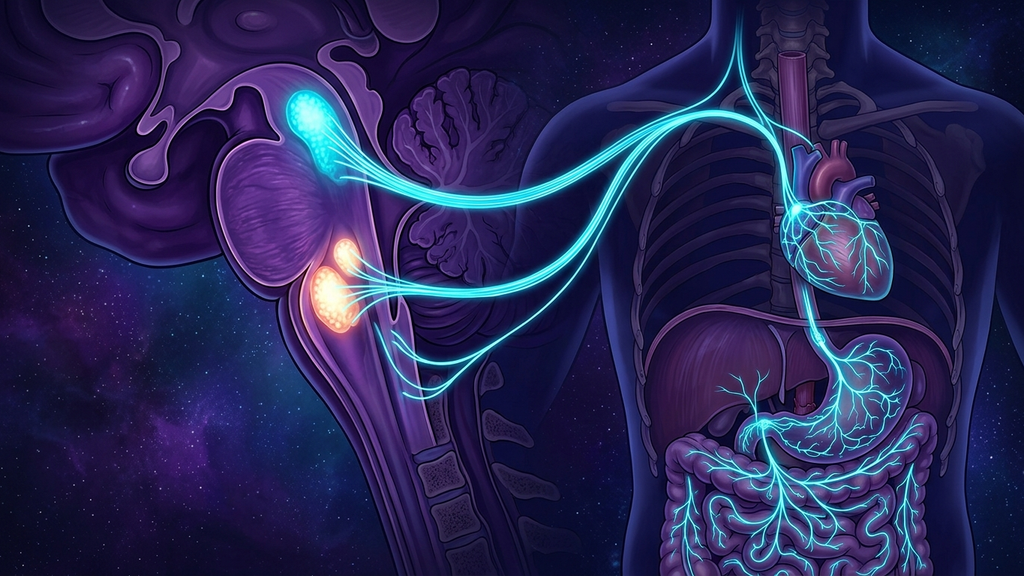
Polyvagal theory, as introduced by Stephen Porges, makes three linked claims. First, the mammalian vagus has two motor branches with two brainstem origins: an older dorsal vagal complex (fibers from the dorsal motor nucleus, associated with immobilization and shutdown) and a newer, myelinated ventral vagal complex (fibers from the nucleus ambiguus, associated with calm engagement). Second, this ventral system is wired to the muscles of the face, larynx, and middle ear, forming a 'social engagement system.' Third, the autonomic nervous system moves through these states in a hierarchy — ventral safety on top, sympathetic mobilization beneath, dorsal shutdown at the bottom — and does so by neuroception, a below-conscious appraisal of threat.
What the Anatomy Solidly Supports
Several planks are anatomically uncontroversial. The vagus genuinely does have two distinct motor origins. The nucleus ambiguus (the brainstem nucleus giving rise to myelinated cardiac vagal fibers) is real and distinct from the dorsal motor nucleus (the nucleus supplying largely unmyelinated fibers to the sub-diaphragmatic gut). This is textbook. So is the observation that the fast, myelinated cardiac branch provides beat-to-beat parasympathetic braking (moment-to-moment vagal restraint of heart rate) — the mechanism that produces respiratory sinus arrhythmia and much of measurable heart-rate variability.
The shutdown physiology is also on firm ground. Profound dorsal-vagal activation producing bradycardia and immobilization is a documented reflex — the diving response and vasovagal syncope are clean examples, where heart rate can drop by 30–50% or more within seconds. The clinical picture of freeze and collapse maps onto genuine autonomic events. Practitioners who use the freeze/shutdown frame to validate a patient's collapse as a physiological reflex rather than a failure of will are standing on solid anatomy.
What Is Contested
The friction is in the connective tissue between the anatomy and the story. Comparative anatomists have pushed back on the claim that a myelinated, nucleus-ambiguus cardiac vagus is uniquely mammalian — myelinated vagal cardiac fibers and nucleus-ambiguus-like organization appear in some non-mammalian vertebrates, which weakens the strict evolutionary hierarchy the theory leans on. The critique, most prominently from Paul Grossman and colleagues, is not that the branches don't exist; it is that the phylogenetic narrative built on top of them overreaches.
Two other claims are softer than they are often presented:
- The three-state hierarchy. The clean ladder — ventral, then sympathetic, then dorsal — is a useful heuristic, but autonomic states are not strictly hierarchical or mutually exclusive. Blended states (sympathetic arousal with vagal brake still partly engaged) are common and measurable, and don't fit a single ladder.
- Respiratory sinus arrhythmia as a clean 'ventral vagal' index. RSA reflects cardiac vagal tone, which is well established. But equating a given HRV value with a specific socioemotional state is an inferential leap the raw signal does not license.
Note what is not being said here. None of this makes the vagus unimportant, none of it denies that ~80% of vagal fibers are afferent, and none of it invalidates the felt experience clinicians work with. The dispute is narrow and anatomical.
Using the Useful Parts Without Overclaiming
The practitioner's job is not to adjudicate an academic dispute — it is to use what works and represent it honestly. Here is a defensible line to walk.
Keep the vagal-tone frame. Cardiac vagal braking is real, measurable, and trainable. Interventions that lengthen exhalation, extend the baroreflex's low-threat window, or improve HRV are acting on genuine physiology. You are not overclaiming when you say slow breathing increases vagal restraint of the heart.
Keep the freeze/shutdown physiology. Dorsal-vagal immobilization is a documented reflex. Validating a patient's collapse, dissociation, or 'going limp' as a bottom-up autonomic event — not cowardice, not choice — is both compassionate and accurate.
Hold the evolutionary story loosely. The phylogenetic ladder is a teaching metaphor. Present it as a map, not as settled comparative neuroanatomy, and you stay honest.
Don't read specific emotions off a single number. An HRV reading tells you about vagal braking capacity. It does not certify 'ventral safety' as a discrete diagnosable state. Treat the metric as a physiological readout, not a mood scanner.
What This Means for Practitioners
Polyvagal theory is best understood as a clinically generative framework wrapped around a partly contested evolutionary claim. Roughly three of its planks — two vagal motor branches, real shutdown physiology, and trainable cardiac vagal tone — are anatomically sound. One or two — the strict phylogenetic hierarchy and the tight state-to-emotion mapping — are where careful practitioners should soften their language. You lose nothing clinically by making that distinction, and you gain credibility with the physicians and skeptics in your audience who already know the critique exists.
The deeper point is that patients do not need the strongest version of the theory to benefit from it. They need the accurate version: their body has a fast vagal brake, it has a genuine shutdown reflex, and both are physiological rather than characterological. That is enough to change how someone relates to their own nervous system — and it has the advantage of being true.
Reference: Porges, Polyvagal Theory (Cleveland Clinic Journal of Medicine, 2009); Grossman & Taylor, Biological Psychology — critique of the respiratory-vagal and phylogenetic claims (2007).