Adrenaline Dumps at 3 AM: The Nocturnal Autonomic Surge That Isn't in Your Head
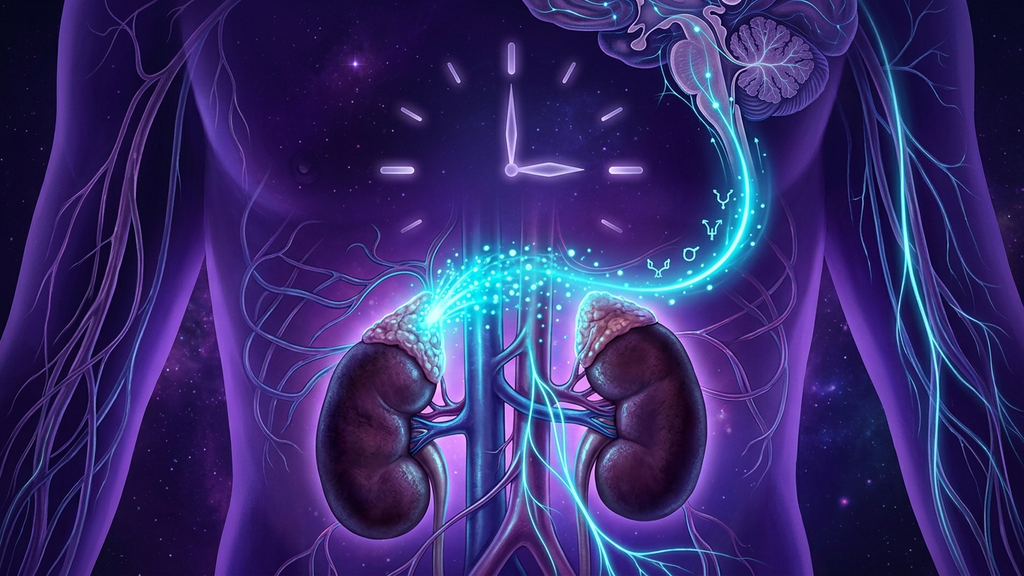
It is almost always the same window. Between 2 and 4 in the morning the patient snaps fully awake — heart hammering, chest tight, a flood of dread arriving before a single anxious thought does. There is nothing to be afraid of and nothing to solve, yet the body is unmistakably in alarm. They are told it is insomnia, or stress, or anxiety, and handed a sleep-hygiene checklist. But the timing is too consistent to be psychological noise. This is a physiological event on a clock — a nocturnal collision of hormonal rhythm, fuel supply, and autonomic tone — and once you see the mechanism, the 3 AM wake-up stops being a mystery and becomes a readout.
The clock behind the wake-up
Your stress hormones are not released at a constant rate; they follow a strict daily rhythm. Cortisol, the primary glucocorticoid, reaches its lowest point around midnight and then begins a steep climb that peaks shortly after waking — the cortisol awakening response. That climb does not start at your alarm. It starts in the small hours. By roughly 3 AM the hypothalamic-pituitary-adrenal axis (the brain-to-adrenal circuit that governs the stress response) is already ramping, and layered on top of cortisol is a parallel rise in catecholamines (the adrenaline-family hormones, chiefly adrenaline and noradrenaline).
In a well-regulated nervous system this pre-dawn rise is silent. You sleep straight through it because the ascent is gradual and the vagal braking system holds arousal in check. The problem is not that the surge exists — it exists in everyone. The problem is what happens when the surge is amplified and the brake is absent at the same hour.
Why the vagal brake fails at night
Vagal tone is not constant across the sleep cycle. Parasympathetic dominance is strongest in deep, slow-wave sleep and drops sharply during REM sleep (the dream-heavy stage in which autonomic control becomes markedly more variable), which clusters in the second half of the night — precisely the 2-to-4 AM window. During REM, the autonomic system becomes markedly more sympathetically weighted: heart rate and blood pressure grow variable, and vagal restraint loosens. Heart-rate variability, the most accessible index of vagal tone, falls measurably in the pre-dawn hours in people with autonomic dysfunction.
So the pre-dawn cortisol-and-adrenaline ramp meets a nervous system whose braking cable is at its slackest. In someone with already-low baseline vagal tone — the dysautonomia patient, the long-COVID patient, the chronically stressed — there is not enough parasympathetic counterweight to absorb the rise. The surge crosses the arousal threshold, and the person is ejected from sleep into full sympathetic activation. This is the baroreflex-and-vagal safety net failing exactly when the load peaks.
The blood-sugar accelerant
There is a second trigger stacked on the first, and it is metabolic. By the middle of the night you may be eight to ten hours past your last meal, and blood glucose drifts toward its nightly low. The brain will not tolerate a falling glucose supply, so it defends itself the only way it can: counter-regulation. It orders a release of adrenaline and cortisol to mobilize stored glucose from the liver.
That is the point. The very hormones already rising on the circadian schedule get an extra, sharp kick from the nocturnal glucose dip. Adrenaline does its metabolic job — it pulls sugar out of the liver — but adrenaline is not selective. The same molecule that raises blood glucose also drives the heart, opens the sweat glands, and lights up the brain's threat circuitry. So the patient wakes with a pounding heart, damp sheets, and a wave of doom, because that is the exact symptom signature of an adrenaline release. The reactive-hypoglycemia arm and the circadian arm are firing the same chemistry at the same hour.
This is not anxiety — read the sequence
The single most clinically useful distinction to give these patients is the order of events. In a primary anxiety attack, the frightening thought or feeling generally comes first and the physical symptoms follow. In a nocturnal autonomic surge, the physical event comes first — the person is asleep, with no thought at all, and is woken by the pounding heart and the adrenaline. The dread is the mind's interpretation of a body that is already in full alarm, not the cause of it.
This is where interoception (the brain's perception of the body's internal state) closes the loop into a spiral. The brain feels the racing heart, correctly senses "high alarm," and — finding no external threat — manufactures a psychological one to match the physiology. Now genuine anxiety piles onto the chemical surge, sleep is gone for an hour or two, and the whole episode gets misfiled as a panic disorder. Naming the true sequence for the patient is often the first thing that breaks the spiral, because it tells them the terror is downstream of the chemistry, not evidence that something is wrong with their mind.
The pattern, in numbers
- The window is tight. These events cluster in the 2-to-4 AM band, tracking the REM-heavy, low-vagal second half of the night.
- Cortisol is already climbing. It bottoms near midnight and can rise by roughly 50 percent or more across the pre-waking hours as the awakening response builds.
- The fuel gap is real. By 3 AM many people are 8 to 10 hours fasted, deep into the window where a glucose dip provokes counter-regulation.
- Vagal tone is measurably low. HRV drops in the pre-dawn hours, and roughly 80 percent of vagal fibers are afferent — sensory — which is why a body-first surge so readily hijacks the brain's threat appraisal.
What this means for practitioners
Because the surge is built from three stacked drivers — circadian ramp, low nocturnal vagal tone, and a metabolic dip — the useful interventions target the drivers, not the fear.
- Steady the overnight fuel supply. A small protein-and-fat-forward snack before bed can blunt the middle-of-the-night glucose trough that triggers counter-regulation. Alcohol does the opposite — it causes a rebound sympathetic surge as it clears, often at exactly 3 AM — and is worth removing as a test.
- Give the patient an in-the-moment vagal tool. When they wake in alarm, slow breathing with a long exhale, gentle humming, or cool water on the face engages the vagal brake directly and can shorten the episode instead of leaving them to ride it out.
- Build daytime vagal reserve. The real fix is raising baseline parasympathetic tone so the nightly ramp has something to push against. Slow-breathing practice, consistent wake times to anchor the cortisol rhythm, and tracked HRV over weeks are the levers.
- Address the daytime sympathetic load. A nervous system running hot all day arrives at night with no reserve. Caffeine timing, chronic stressors, and overtraining all raise the pre-dawn baseline the surge builds on.
- Reframe it explicitly. Tell the patient the sequence: the body fires first, the fear is the interpretation. That single correction often does more for the 3 AM dread than any sedative.
Reference: Journal of Clinical Endocrinology & Metabolism — circadian cortisol rhythm and nocturnal autonomic arousal (2021).