The Dysautonomia Tetrad: The Four-Symptom Cluster Behind 'It's Just Anxiety'
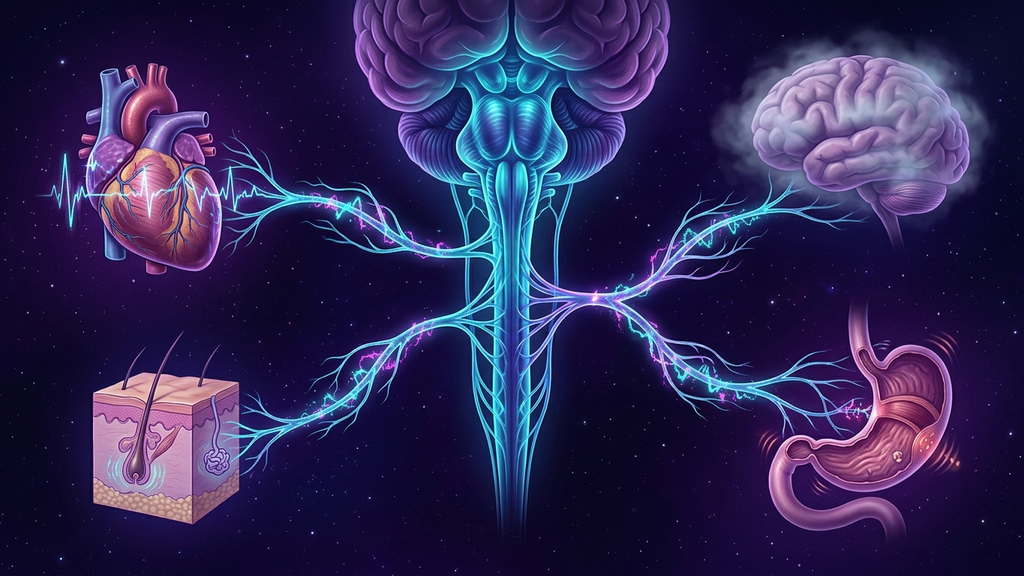
The patient has seen four doctors. The cardiologist found a racing heart and no heart disease. The sleep clinic found exhaustion and no sleep disorder. The neurologist found brain fog and a normal scan. The gastroenterologist found a temperamental gut and no ulcer. Four normal workups, four shrugs, and one quietly devastating conclusion offered to the patient: it is probably anxiety. It is not anxiety. It is one autonomic nervous system dysregulating four organs at once — the dysautonomia tetrad.
Naming the Tetrad
The dysautonomia tetrad is a four-symptom cluster that recurs so reliably it functions as a signature. Its four members are:
- Orthostatic intolerance / POTS — symptoms on standing, classically a sustained heart-rate rise of ≥ 30 bpm within 10 minutes upright without a fall in blood pressure. The heart races to defend a pressure the autonomic system can no longer hold.
- Fatigue — a profound, non-restorative exhaustion out of proportion to activity and unrelieved by sleep.
- Brain fog — impaired concentration, word-finding, and processing speed, often worse upright and worse late in the day.
- GI dysmotility — nausea, early fullness, bloating, and irregular transit as the gut's own pacing falters.
(A defensible substitute or fifth member is thermoregulatory / sudomotor instability — erratic sweating and heat intolerance — which shares exactly the same driver.)
One Nerve, Four Territories
The reason these four cluster is that they are governed by overlapping autonomic circuitry, with the vagus nerve (the tenth cranial nerve and principal parasympathetic conduit) and its brainstem partners running the show across all four territories. The autonomic nervous system is not organ-specific plumbing; it is a single distributed control network. When its balance tips toward chronic sympathetic dominance and suppressed parasympathetic tone, every organ that network touches drifts at the same time.
The keystone is interoception (the brain's sense of the internal state of the body — heartbeat, breath, gut, temperature). Roughly 80% of vagal fibers are afferent, meaning the majority of the nerve's job is reporting the body's condition back to the nucleus tractus solitarius (the brainstem hub that receives visceral sensation). When that afferent stream is degraded, the brain is not just controlling the body poorly — it is doing so on corrupted sensory data. Bad input at one hub produces bad output to many organs. That is how one lesion of regulation becomes four symptoms.
Walking the Four Branches
- The heart. Without reliable baroreflex signaling, standing up drops blood toward the legs and the autonomic system overcorrects with tachycardia. The racing heart is a compensation, not a cardiac disease.
- The energy system. Chronic sympathetic overdrive is metabolically expensive and pro-inflammatory; the body runs hot and recovers poorly, producing fatigue that sleep cannot touch.
- The brain. Cerebral perfusion and arousal regulation both depend on autonomic control; when perfusion sags on standing and arousal is dysregulated, cognition blurs into fog.
- The gut. Low parasympathetic drive slows gastric emptying and intestinal transit, so the same nerve deficit that races the heart stalls the gut.
Four organs, four symptoms, one upstream cause. The symptoms look unrelated only because our medical system is organized by organ, not by control network.
The Numbers
- Postural tachycardia is defined by a heart-rate rise of ≥ 30 bpm on standing (≥ 40 bpm in adolescents) — an objective, measurable line under a symptom often dismissed as nerves.
- Roughly 80% of vagal fibers are afferent, so this is fundamentally a disorder of sensing the body, not only of commanding it.
- Dysautonomia disproportionately affects young women — many cohorts run on the order of 4 to 5 women for every man — a demographic pattern that has historically driven the mislabeling of a mechanical disorder as psychological.
- Low heart-rate variability, the surface readout of suppressed vagal tone, tends to accompany the full cluster — one dial that moves with all four symptoms.
Why 'Just Anxiety' Is the Wrong Answer
The anxiety label is not merely unkind — it is mechanistically backwards. A racing heart, restlessness, and difficulty concentrating are indeed features of a sympathetically activated body — but in the tetrad the sympathetic activation is the disease, driven by failing autonomic regulation, not a reaction to worried thoughts. The physiology that anxiety borrows, dysautonomia owns. Telling these patients to calm down asks them to think their way out of an autonomic imbalance, which is like asking someone to reason their way out of a fever. The tell is that the four symptoms are yoked together and track with posture, heat, and effort — anxiety does not obey a tilt table.
What This Means for Practitioners
The single most useful move is pattern recognition: when three or four of these arrive together, stop working them up as separate mysteries and name the cluster.
- Count the branches. Orthostatic symptoms + unrelenting fatigue + cognitive fog + GI dysmotility is a tetrad, not a coincidence. The co-occurrence is the diagnostic signal.
- Measure what's dismissible. A ten-minute stand test and a heart-rate-variability reading convert "it's in your head" into numbers on a page — and validation is itself therapeutic.
- Treat the network, not the four outputs. Interventions that restore autonomic balance and vagal tone act on the shared driver; chasing each organ separately treats echoes.
- Retire the anxiety default. Reserve the psychological label for after the autonomic network has been assessed, not before — and never as a substitute for the assessment.
For the patient, the reframe is the whole medicine. Four unrelated diagnoses say: you are broken in four ways and no one knows why. One nerve says: you have a single, real, mechanical problem with a name. The dysautonomia tetrad takes a multi-system mystery illness and unifies it under one dysregulated control network — and a problem with one address is a problem that can finally be worked.
Reference: Clinical Autonomic Research — multisystem symptom clustering in autonomic dysfunction (2024).