The Vagus and Your Metabolic Rate: How Autonomic Tone Sets Your Baseline Burn
She does everything right. She eats clean, she trains, she sleeps as well as her racing nervous system will allow — and the scale will not move, her hands are always cold, and she feels simultaneously exhausted and unable to switch off. Her thyroid panel comes back "normal," so she is told her metabolism is simply slow and she should eat less and move more. But metabolic rate is not a fixed engine size you are born with. It is a setting — a thermostat continuously tuned by the autonomic nervous system — and the vagus nerve is one of the two hands on that dial. When autonomic balance tips the wrong way, the body can bank its energy, blunt its heat production, and starve its own furnaces while every standard lab reads normal.
Metabolic rate is an autonomic decision, not a fixed number
Resting metabolic rate (the energy your body burns at rest just to stay alive) accounts for roughly 60 to 70 percent of total daily energy expenditure. It is not a static quantity. Minute to minute, it is negotiated by the balance between the two arms of the autonomic nervous system: the sympathetic branch that spends and mobilizes, and the parasympathetic branch — carried overwhelmingly by the vagus nerve — that conserves, digests, and restores.
The intuitive story is that sympathetic drive raises the burn and vagal drive lowers it, and in the acute sense that is true — a burst of adrenaline transiently lifts metabolic rate. But the chronic picture inverts that intuition. Sustained sympathetic dominance with low vagal tone does not produce a lean, high-burning machine. It produces a body locked in threat physiology: energy hoarded, thyroid conversion throttled, fat oxidation suppressed, and heat production down-regulated. The vagus is not the brake on metabolism. It is the signal of safety that permits the body to run its expensive maintenance programs at all.
The thyroid axis runs downstream of autonomic tone
The engine most people blame — the thyroid — is itself heavily gated by the autonomic state. The hypothalamic-pituitary-thyroid axis (the brain-to-gland circuit that sets thyroid output) does not operate in isolation. Chronic sympathetic overdrive and the elevated cortisol that travels with it suppress the peripheral conversion of the storage hormone T4 into the active hormone T3, and they push conversion instead toward reverse T3, a metabolically inert form that occupies receptors without switching them on.
This is why the classic panel misleads. TSH and T4 can sit squarely in range while the tissue-level thyroid signal — the T3 actually reaching the mitochondria — is quietly low. The patient has the symptoms of hypothyroidism, the cold intolerance and the weight that will not shift and the fatigue, with a lab sheet that exonerates the gland. The failure is not in the thyroid. It is in the autonomic and stress signaling that decides how much of the thyroid's product ever gets activated.
Brown fat, thermogenesis, and the heat you are not making
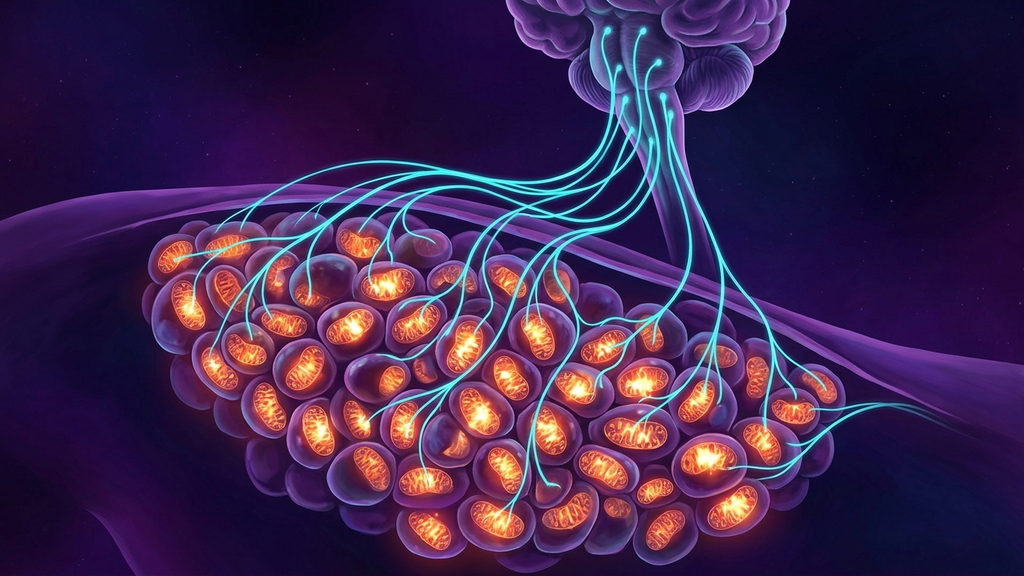
The most literal expression of metabolic rate is heat, and the organ dedicated to making it is brown adipose tissue — a specialized fat, concentrated around the neck, collarbones, and spine, packed with mitochondria that burn fuel purely to generate warmth. This is thermogenesis (the production of body heat), and its non-shivering form runs through a mitochondrial protein called UCP1 that deliberately uncouples fuel-burning from energy storage so the released energy escapes as heat.
Here is the mechanistic knot. Brown fat is activated by sympathetic nerve endings and by catecholamines (the adrenaline-family signaling molecules). So why does chronic sympathetic dominance leave patients cold rather than blazing? Because sustained overdrive produces receptor desensitization: the beta-adrenergic receptors on brown fat, endlessly bathed in stress signaling, become blunted and unresponsive, the way a nose stops smelling a perfume it is constantly exposed to. Active, cold-recruitable brown fat can add meaningful daily energy expenditure and is far more abundant in lean, cold-tolerant people than in the metabolically stuck. When the autonomic system loses its healthy oscillation — its capacity to swing into genuine sympathetic activation and then recover into vagal rest — the thermogenic furnaces stop being called on cleanly. The patient runs cold not from too little sympathetic tone but from a system so chronically strained it can no longer produce a crisp, effective thermogenic pulse.
The wired-but-cold-and-stuck pattern is one lesion, not three
Assemble the pieces and a single autonomic signature emerges, which I will call the low-vagal metabolic bottleneck: high resting sympathetic tone, collapsed vagal tone, and a metabolism that behaves as if it is under siege.
- Cold hands and feet — peripheral vasoconstriction from sympathetic drive plus blunted non-shivering thermogenesis.
- Weight that will not move — suppressed T4-to-T3 conversion and down-regulated fat oxidation in a body prioritizing storage.
- Wired but exhausted — elevated sympathetic arousal with no vagal recovery, so the person feels revved and depleted at once.
- Low, flat heart-rate variability — the fingerprint of poor vagal tone, and a documented correlate of metabolic syndrome risk.
- Poor post-meal recovery — digestion, a parasympathetic "rest-and-digest" function, is crowded out by chronic sympathetic load.
Low heart-rate variability is not a curiosity here; large cohort studies link reduced vagal-mediated HRV to a substantially higher risk of developing metabolic syndrome over time, and roughly 1 in 3 adults already meets criteria for that cluster. The vagus is measurably upstream of the very disease pattern these patients are sliding toward.
Why interoception ties the whole loop together
Roughly 80 percent of vagal fibers are afferent (carrying signals from the body up to the brain, not commands down). That means the vagus is first and foremost a sensory nerve — the backbone of interoception (the brain's sense of the body's internal state). It continuously reports the status of the gut, the liver, the heart, and metabolic signals to the brainstem, and the brain uses that stream to decide how freely to spend energy. When afferent vagal signaling is degraded or drowned out by sympathetic noise, the brain loses accurate information about the body's fuel state and defaults to caution: conserve, store, stay cool. The metabolic slowdown is not a malfunction. From the brain's impoverished vantage point, it is a rational response to a body it can no longer clearly read.
What this means for practitioners
The lever that actually moves this system is not another diet or a lower calorie target — both of which read to a threatened nervous system as further scarcity and can deepen the down-regulation. The lever is autonomic rebalancing: restoring vagal tone so the brain regains permission to spend.
- Train the vagal brake. Slow breathing near six breaths per minute with extended exhales, humming, gargling, and cold-water face immersion all raise parasympathetic tone. Tracked over weeks with HRV, the goal is a rising baseline, not a single good reading.
- Use cold deliberately, not chronically. Brief, tolerable cold exposure recruits brown fat and can restore thermogenic responsiveness — but only against a backdrop of adequate recovery. Chronic cold on top of chronic stress just adds sympathetic load.
- Stop under-eating a threatened system. Aggressive restriction in a low-vagal patient suppresses T3 conversion further. Adequate protein, adequate total energy, and post-meal walks that support digestion do more for the burn than another deficit.
- Read the panel correctly. When symptoms scream hypothyroid but TSH and T4 are normal, look at free T3 and reverse T3 and consider the autonomic and cortisol context, not just the gland.
- Frame it honestly for the patient. This is not a slow metabolism they were born with and cannot change. It is a thermostat set to "conserve" by a nervous system that does not yet feel safe — and thermostats can be reset.
Reference: Nature Reviews Endocrinology — autonomic regulation of metabolism and thermogenesis (2018).