The Vagal-Gut Trifecta: Why Gastroparesis, SIBO, and Reflux Travel Together
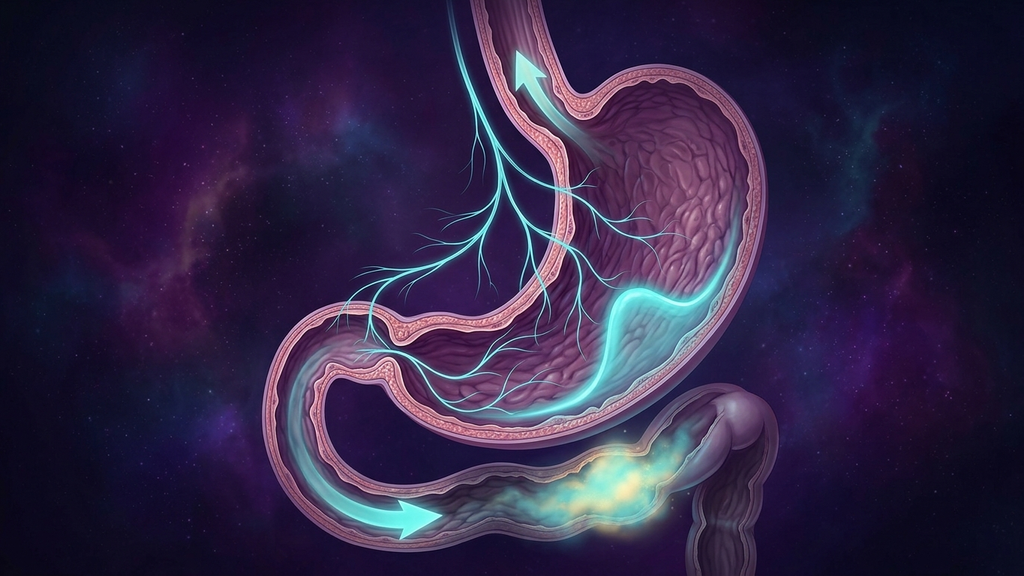
A patient carries three GI diagnoses collected over three years: reflux from the first gastroenterologist, small intestinal bacterial overgrowth from the second, and delayed gastric emptying from the third. Each was treated as its own disease, and each treatment quietly undermined the others. In reality these are not three diseases — they are three pressure points along a single failing pipeline. This is the vagal-gut trifecta: gastroparesis, SIBO, and reflux, all downstream of a gut that has lost its forward drive.
Naming the Trifecta
The vagal-gut trifecta is the clustered appearance of three conditions that share one mechanism — insufficient vagal signaling to the gut:
- Gastroparesis — delayed gastric emptying, in which the stomach empties too slowly despite no physical blockage. Food sits, ferments, and backs up.
- SIBO — small intestinal bacterial overgrowth, an abnormal accumulation of bacteria in the small bowel, a region that is normally kept relatively sparse.
- Reflux / GERD — retrograde flow of stomach contents past the lower esophageal sphincter, driven here by pressure from below rather than by an intrinsically weak valve.
They arrive together because they are the beginning, middle, and end of the same story: a gut that no longer moves its contents downstream on schedule.
The Engine Room: The Migrating Motor Complex
Between meals, the healthy gut runs a housekeeping program called the migrating motor complex (a recurring wave of muscular contraction that sweeps residue and bacteria from the stomach through the small intestine, roughly every 90 to 120 minutes in the fasting state). Think of it as the gut's cleaning cycle. It only runs when you are not eating, and it depends on healthy signaling — much of it vagal — to fire on time and sweep with force.
The vagus nerve (the tenth cranial nerve and the main parasympathetic supply to the gut) provides the efferent drive (outgoing motor commands from brainstem to organ) that sets gastric emptying rate and helps pace this sweep. When vagal efferent drive is low — from diabetes, surgery, viral injury, or systemic dysautonomia — the housekeeping wave weakens or skips. The pipeline stops cleaning itself.
The Cascade, Step by Step
Follow one nerve deficit forward and the trifecta assembles itself:
- Low vagal drive → slowed emptying. The stomach, under-instructed, empties late. Contents pool. This is gastroparesis.
- Stasis → overgrowth. A gut that does not sweep is a gut that lets bacteria settle where they should not. Stagnant small-bowel contents become a culture medium. This is SIBO.
- Fermentation and back-pressure → valve failure. Overgrowth ferments carbohydrates into gas; a distended, gas-filled, slow-to-empty stomach raises intragastric pressure and pushes contents up against the lower esophageal sphincter. This is reflux.
Each stage feeds the next. Reflux is not a coincidence sitting on top of gastroparesis; it is gastroparesis expressing itself at the top of the stack. The through-line is directional failure — the gut has lost its ability to move things one way, from mouth toward colon.
The Numbers
- Roughly 80% of vagal fibers are afferent (sensory, running gut-to-brain), which means vagal gut disease is as much a sensing problem as a motility problem — the brain loses accurate reporting on fullness and transit.
- The migrating motor complex cycles approximately every 90–120 minutes during fasting; suppress it and small-bowel clearance falls sharply.
- Gastric emptying studies define delay as roughly > 10% of a standardized meal retained at 4 hours (or > 60% at 2 hours) — a hard, measurable line that reframes vague "bloating" as documented dysmotility.
- SIBO is strongly associated with dysmotility states; when transit is restored, breath-test positivity and symptoms frequently recede together, underscoring that overgrowth is downstream of stasis.
Why Treating One Fails
The trifecta explains a maddening clinical pattern: each single-target therapy can make the whole worse. Acid-suppressing drugs for reflux remove one of the body's own defenses against small-bowel overgrowth, and can nudge SIBO along. Antibiotics for SIBO clear the overgrowth but do nothing for the stasis that caused it, so it returns. Prokinetics aimed at gastroparesis are the only intervention that addresses the shared upstream cause — forward motion — which is why they can help all three at once. When three diagnoses respond to the same lever, that lever is the real disease.
What This Means for Practitioners
The reframe is to stop treating the trifecta as three problems in a queue and start treating it as one problem with three symptoms — and to sequence interventions accordingly.
- Read the cluster as a signature. Reflux + bloating + early satiety + a positive breath test is not three unlucky diagnoses; it is a motility story. Look upstream for the vagal or autonomic driver.
- Restore motion before, or alongside, clearing bacteria. Killing overgrowth without restoring the migrating motor complex invites relapse. Sequence toward transit first.
- Question reflexive acid suppression. When the reflux is a pressure phenomenon from delayed emptying, lowering acid treats the symptom while removing a barrier to overgrowth.
- Protect the fasting window. The housekeeping wave only runs between meals; constant grazing suppresses the very cycle these patients most need. Spacing meals is a mechanistic intervention, not a lifestyle aside.
- Look for the systemic autonomic picture. Gut dysmotility rarely travels alone; orthostatic symptoms and low heart-rate variability point to a whole-body vagal problem the gut is merely announcing first.
Seen whole, the vagal-gut trifecta gives the patient something better than three prescriptions: a single explanation. The stomach, the small bowel, and the valve are not independently broken. One nerve stopped keeping the line moving, and everything downstream backed up. Fix the drive, and the pipeline drains in the direction it was built to flow.
Reference: Neurogastroenterology & Motility — vagal control of gastric emptying and small-bowel clearance (2024).