Ultrasonic Vagus Nerve Stimulation — Quantum Coherence Restoration Protocol
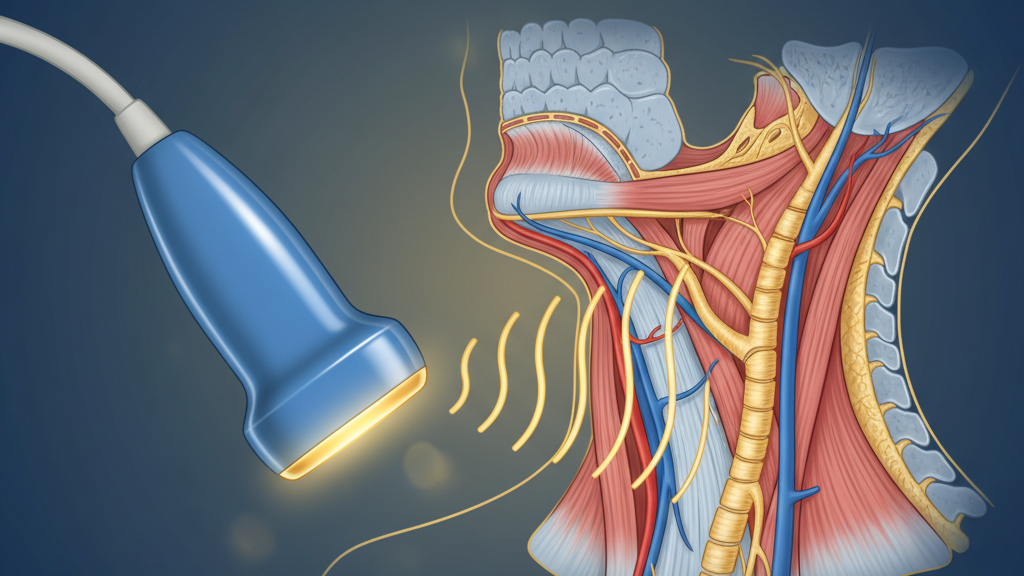
The vagus nerve is the body's longest and most consequential cranial nerve. It runs from the brainstem to the gut, branching to nearly every internal organ on the way. Through it, the brain monitors and adjusts heart rate, respiration, digestion, immune activity, and inflammation. Vagal tone — the steady-state quality of this signaling — predicts cardiovascular health, emotional regulation, and recovery from stress better than almost any other single physiological measure.
Vagal nerve stimulation (VNS) has been an FDA-approved therapy since 1997, originally for refractory epilepsy and later for treatment-resistant depression. The original devices were implanted, with a cuff electrode wrapped around the cervical vagus. The next generation is non-invasive, including transcutaneous electrical and — most interestingly — ultrasonic vagal stimulation. The ultrasonic version may be more than a less-invasive delivery mechanism. It may be doing something fundamentally different from electrical stimulation.
Why the Vagus Nerve Is Special
Most peripheral nerves are dominated by efferent motor fibers carrying commands outward from the brain. The vagus is the opposite: roughly 80% of its fibers are afferent, carrying signals from the body back to the brain. Vagal afferents reach the nucleus tractus solitarius in the brainstem, which projects to the locus coeruleus, the basal forebrain, the amygdala, and on through to virtually every part of the cortex.
Activate the vagus, and you do not just stimulate one circuit — you broadcast a neuromodulatory state across the whole brain. The released cocktail of norepinephrine, acetylcholine, and serotonin is sometimes called the plasticity cocktail, because it dramatically lowers the threshold for synaptic change. This is why VNS paired with rehabilitation accelerates recovery from stroke, why it improves outcomes for refractory depression, and why timing of stimulation relative to behavior matters so much.
Why Ultrasound Changes the Picture
Electrical VNS works, but it is non-specific: every fiber in the cuff is stimulated, including the efferent motor fibers that produce the well-known side effects (hoarseness, throat tightness, cardiac slowing). It is also necessarily invasive in its high-quality forms, since the cervical vagus is hard to reach electrically through skin.
Focused ultrasound has neither limitation. It can be steered to the nerve through skin and tissue without surgery, and it can target specific fiber populations selectively. More interestingly, ultrasound is a mechanical stimulus, not an electrical one — and the vagus nerve is densely populated with microtubule-rich axons that are themselves mechanosensitive. Ultrasound is not just an electrical pulse delivered by a different route. It is a different kind of input entirely.
The Coherence-Restoration Hypothesis
If you take the microtubule-coherence picture seriously, the vagus nerve becomes the body's wiring diagram for system-wide quantum coherence. Vagal afferents bundle thousands of microtubule-rich axons in close apposition. The ordered structure resembles, at a much larger scale, the kind of geometry that supports coherent energy transfer in photosynthetic proteins.
Ultrasound at the right frequency and intensity might do something none of our other neuromodulation tools can: drive coherent vibrational modes along these bundles, restoring or extending coherence times that have been degraded by stress, inflammation, or aging. The downstream consequences would be felt as parasympathetic activation, but the underlying mechanism would be a reset of the cellular substrate that ordinary vagal signaling depends on.
"Vagal nerve stimulation creates a neuromodulatory state across the whole brain by releasing acetylcholine and norepinephrine. The effect is timing-dependent and remarkably broad. Whatever cellular mechanism underlies this state, it operates on a scale that requires global coordination across enormous distances of axonal tissue." — Hays, Neurotherapeutics, 2016
A Concrete Protocol
The most rigorous coherence-restoration protocol combines four elements:
- Baseline measurement. Heart rate variability (HRV) is the best non-invasive readout of vagal tone. A few minutes of resting HRV before and after each session establishes the trajectory.
- Targeted ultrasound. A focused transducer aimed at the cervical vagus, parameters tuned to the bundled axon resonance frequency rather than to electrical-equivalent doses. Sessions of 5–15 minutes appear sufficient.
- Slow-paced breathing. Six breaths per minute synchronizes respiratory and cardiac rhythms, raising HRV in real time and amplifying the parasympathetic state the ultrasound is encouraging.
- Closed-loop feedback. Real-time HRV biofeedback during the session lets the user (or an automated controller) optimize stimulation parameters as physiological state evolves.
The combination is more than the sum of its parts. Slow breathing alone improves HRV. Ultrasound alone modulates the nerve. Together, with HRV biofeedback closing the loop, the protocol becomes a self-tuning intervention.
Therapeutic Targets to Watch
- Treatment-resistant depression. Implanted VNS already has FDA approval; non-invasive ultrasonic VNS may broaden access dramatically.
- Long COVID and chronic fatigue. Both involve dysautonomia and impaired vagal function. Coherence restoration via ultrasound has obvious appeal as a low-risk intervention.
- Inflammatory conditions. The cholinergic anti-inflammatory pathway runs through the vagus. Strengthening vagal tone reduces TNF-α and other inflammatory mediators.
- Recovery from cardiac events. Low HRV is among the strongest predictors of post-MI mortality. Anything that durably raises vagal tone is worth examining.
- Cognitive enhancement and meditation deepening. Vagal tone correlates with attentional control, emotional regulation, and the ease of entering deep meditative states.
Open Questions
- What is the optimal ultrasound frequency for cervical vagal modulation? Current protocols borrow parameters from cortical work; the bundled-axon geometry may call for different settings.
- Does the effect depend on coherence in any technical sense, or is it entirely accounted for by mechanical activation of standard mechanosensitive channels?
- How durable are the changes? Daily practice for weeks shifts baseline HRV upward; whether this reflects sustained substrate-level change or repeated state-level activation is not yet clear.
Ultrasonic vagal stimulation is in its early clinical stages. The basic safety profile is excellent, the mechanism is plausible, and the addressable conditions list is unusually large. It is one of the more promising tools in the next decade of bioelectric medicine.
Further Reading
Hays S.A. (2016). Enhancing Rehabilitative Therapies with Vagus Nerve Stimulation. Neurotherapeutics, 13(2), 382–394. doi:10.1007/s13311-015-0417-z