The Microtubule-EEG Interface — Reading Quantum Consciousness Non-Invasively
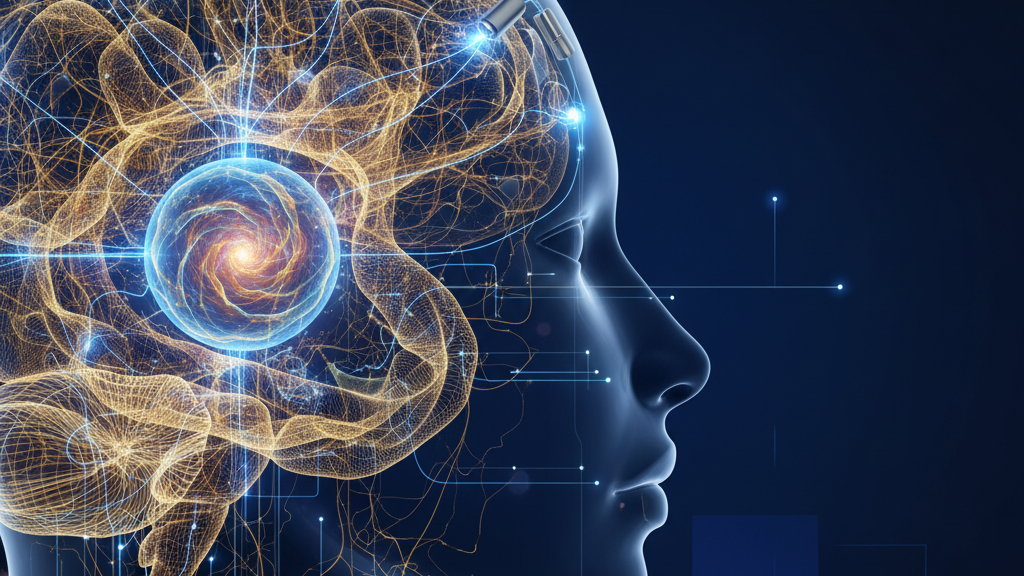
Electroencephalography (EEG) is one of the oldest and most enduring tools in neuroscience. Place electrodes on the scalp, amplify the microvolt-scale signals produced by synchronized cortical activity, and you obtain a millisecond-resolution window onto large-scale brain function. EEG is cheap, non-invasive, and clinically robust. It tells us a great deal about classical neural dynamics — and very little about whatever quantum processes might be happening underneath.
The interesting question, raised most directly by Stuart Hameroff in his 2014 review, is whether EEG could be made to detect signatures of quantum-coherent processes in microtubules. The answer is not obvious — but it is also not obviously "no." With the right analysis methods, modern high-density EEG might already contain quantum signatures we have not been looking for.
What EEG Actually Measures
The EEG signal originates from the synchronized post-synaptic currents of cortical pyramidal neurons. Tens of thousands of these neurons must fire in approximate synchrony for the resulting field to be detectable at the scalp. EEG is therefore inherently a population-level, classical measurement: it tells you about coordinated neural activity at the millimeter spatial scale and millisecond temporal scale.
None of this is suited, at first glance, to detecting quantum events. The relevant quantum collapses in Orch-OR happen at the nanometer scale and on sub-millisecond timescales, inside individual neurons. There is no obvious reason scalp EEG should pick them up at all.
Why It Might Anyway
Three considerations push back against the obvious dismissal:
- Macroscopic readouts of microscopic events are routine in physics. Quantum computers are read out by classical instruments. The signal from a single quantum event is amplified through a chain of interactions until it becomes macroscopic. The same logic applies in the brain: if Orch-OR events drive synchronized firing in surrounding neurons, the resulting classical signature would be exactly what EEG measures.
- 40 Hz gamma synchrony is already that signature. The simplest version of the Hameroff hypothesis is that gamma is the macroscopic readout of quantum collapse events. This is not detection of the quantum events themselves — it is detection of their classical consequences. We may already be seeing the signature; we just may not have recognized what we are looking at.
- Statistical structure could distinguish quantum from classical sources. A purely classical oscillator produces output with specific statistical properties: certain correlations, certain noise floors, certain phase distributions. A signal driven by quantum events should have different statistics — including non-classical correlations between distant measurement points, fine structure within individual oscillation cycles, and unusual phase coherence.
What to Look For
Hameroff's specific proposals for detecting quantum signatures in EEG include:
- Gamma burst fine structure. Standard EEG analysis treats gamma as a continuous oscillation. Looking inside individual gamma bursts at sub-millisecond resolution might reveal discrete events — small steps or jumps — that correspond to individual OR collapses.
- Non-classical correlations between distant electrodes. Bell-type correlations between EEG signals at different scalp locations — correlations stronger than any classical neural connection should produce — would be a powerful signature.
- EEG microstates. The brain spontaneously transitions between a small number of stable spatial patterns of cortical activity, each lasting roughly 80–120 milliseconds. These "microstates" are surprisingly discrete, and their transitions are surprisingly abrupt. Each microstate might correspond to an Orch-OR event, with the discrete transitions reflecting collapse boundaries.
- Anesthetic comparison. Whatever signatures we identify in waking EEG should systematically disappear under general anesthesia. If they don't, they are not specifically quantum signatures of consciousness.
"Quantum coherence in microtubules should produce specific EEG signatures beyond those captured by standard analysis: non-classical correlations between distant electrodes, fine structure within gamma bursts, and discrete state transitions consistent with orchestrated collapse events. Detecting these requires high-density EEG with sub-millisecond resolution and analysis methods specifically designed for the task." — Hameroff, Journal of Consciousness Studies, 2014
The Closed-Loop Possibility
The most ambitious application of this picture is the development of closed-loop systems that detect quantum-coherent states via EEG and respond in real time with targeted ultrasound. The architecture would look like this:
- High-density EEG continuously monitors cortical activity, with custom analysis tracking the proposed quantum signatures.
- A targeting system identifies whether coherent states are present, degraded, or absent in regions of interest.
- Focused ultrasound delivers brief, precisely targeted stimulation to support or restore coherence in specific regions.
- The EEG immediately measures the response, allowing the system to adjust ultrasound parameters in real time.
This is, in form, the same kind of biofeedback architecture used in modern neurorehabilitation. The novelty is in what is being measured and what is being delivered. If even a weak version of this architecture proves clinically useful, it would be the first device that operates explicitly on the quantum substrate of consciousness rather than only on its classical neural correlates.
Permutations Worth Exploring
- What if existing EEG datasets — millions of recordings collected over decades — already contain quantum signatures, just unrecognized because no one analyzed for them? Reanalysis is cheap; this is among the lowest-cost frontiers available.
- What if the EEG microstate framework, which has accumulated substantial empirical support, is actually a description of orchestrated quantum collapse — and standard neuroscience has been describing the right thing in the wrong vocabulary?
- What if individual differences in EEG microstate properties (mean duration, transition statistics, occurrence frequency) reflect individual differences in microtubule coherence — making EEG microstate analysis a non-invasive readout of cytoskeletal health?
- What if combining EEG with magnetoencephalography (MEG) and functional near-infrared spectroscopy (fNIRS) produces a multi-modal signature that no single modality could detect alone?
The Limits of the Approach
EEG is a coarse instrument. Even at its best, it cannot directly observe individual quantum events; it can only observe their macroscopic consequences. A negative result would not falsify Orch-OR — it would only show that the consequences are too small or too dispersed to detect with this method. A positive result, by contrast, would be a major piece of indirect evidence and would point toward the next generation of measurements.
The work is undeniably long-term. But the cost is low, the equipment exists, and the analysis methods are within reach. This is among the cleanest near-term experimental programs available for connecting quantum theories of consciousness to actual measurable data.
Further Reading
Hameroff S. (2014). Quantum coherence in microtubules: A neural basis for emergent consciousness? Journal of Consciousness Studies, 21(3-4), 8–37.