Quantum Entanglement Between Brains — Microtubule Networks as Quantum Communication Channels
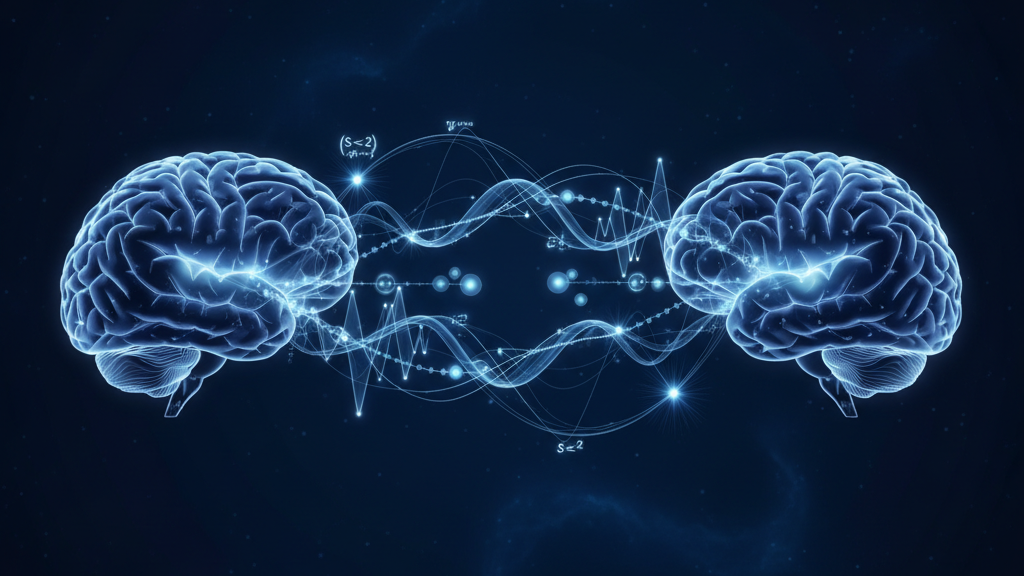
This is the most speculative essay in this series. It deserves a clear caveat at the top: the empirical evidence is sparse, the mechanism is contested, and the standard scientific community treats the entire question with appropriate skepticism. None of that makes the question uninteresting. If microtubules really do sustain quantum coherence in the brain — itself a contested claim — then the further question of whether such coherence can extend across brains follows naturally from the physics. The argument deserves to be examined honestly rather than dismissed reflexively.
What Entanglement Actually Is
Quantum entanglement is not telepathy. It is a precise physical relationship between two systems whose states cannot be described independently. When two particles are entangled and one is measured, the result instantaneously determines the state of the other, no matter how far apart they are. This has been demonstrated in countless experiments, including across distances of more than a thousand kilometers in satellite-based tests.
Crucially, entanglement does not allow signaling. You cannot use it to send messages. The correlations only become apparent when the two distant measurement outcomes are compared — which requires conventional, slower-than-light communication. So any hypothesis about inter-brain entanglement is not a hypothesis about telepathic communication in the everyday sense; it is a hypothesis about correlated brain states that emerge under the right physical conditions.
The Conditions Required
For two systems to become entangled, they must interact in a quantum-coherent way. For two brains to become entangled, three things would need to be true:
- Microtubules in each brain must support quantum-coherent states. This is the Orch-OR substrate hypothesis, which is contested but at least concrete.
- Some physical process must connect the two brains' coherent states. The most-discussed candidates are biophoton emission (the very low-intensity light produced by all living tissue), shared electromagnetic field exposure, or shared environmental quantum states.
- The entangled state must persist long enough to produce measurable correlations. This requires that the same coherence-preserving mechanisms (structured water, hydrophobic shielding) that protect intra-brain coherence also extend to inter-brain interactions.
None of these three conditions is impossible in principle. All of them are speculative in practice. Whether they are jointly achievable is, at present, unknown.
What the Empirical Literature Looks Like
The cleanest experimental program addressing inter-biological correlations comes from Michael Persinger's group at Laurentian University. In a series of papers spanning the 2000s and early 2010s, they reported statistically significant correlations between brain activity in one person and biophoton emissions from cell cultures in another room — when both were exposed to the same rotating magnetic field. The proposed mechanism was a quantum-entanglement-like coupling mediated by the shared field.
"Brain-derived biophoton emissions from one location showed statistically significant correlations with brain electrical activity at another location when both shared exposure to a common rotating magnetic field. The effect is consistent with a quantum-entanglement mechanism but cannot be considered conclusive without independent replication." — Dotta et al., Brain Research, 2011
Persinger's work has been criticized on methodological grounds, and the broader field is genuinely undecided about how to interpret it. The honest position is that there is suggestive data, that it has not been independently replicated at the level required to settle the question, and that the underlying physics has at least one plausible mechanism even if the empirical case is currently weak.
The Maharishi Effect and Why It Is Hard
A separate body of literature concerns the so-called "Maharishi effect" — claimed reductions in crime, accident, and conflict rates in regions where large groups of meditators are present. Several studies, mostly published by researchers affiliated with the Transcendental Meditation movement, report statistically significant effects.
This literature illustrates exactly why claims in this domain are difficult to evaluate. The reported effects are real in the data, but the methodological objections — selection of regions, choice of comparison periods, treatment of confounders — are substantial. Independent replication outside the original research community has been limited. Whether there is anything physical to explain, or whether the effects are statistical artifacts, is genuinely contested.
From the perspective of this essay, the Maharishi effect is interesting because it is the kind of thing that would be predicted if microtubule-mediated inter-brain entanglement were real and amplified by group meditation. It is not, by itself, evidence that such entanglement exists.
What Would a Convincing Experiment Look Like?
To move this question out of speculation, the following would need to be established, ideally by independent labs:
- Direct measurement of quantum coherence in microtubules in vivo, not just in vitro or in extracted protein. This is the foundational requirement; everything else builds on it.
- Demonstration of a physical process (biophoton, electromagnetic, or other) that can couple coherent states across distinct biological systems.
- Pre-registered, double-blind protocols measuring correlated brain activity between physically isolated subjects, with no possibility of conventional communication.
- Replication across labs with independent funding, equipment, and analysis pipelines.
None of this is methodologically out of reach. It is expensive and slow, but it is the kind of thing modern neuroscience is fully capable of doing if the question is judged worth answering.
Permutations Worth Holding
- What if the felt sense of "connection" with another person — the moment of meeting someone's eyes, the shared rhythm in conversation, the experience of group meditation — has a small but real physical correlate in synchronized neural states?
- What if Jung's "collective unconscious" is not a metaphor but a description of weak inter-brain correlations that emerge under specific conditions?
- What if certain ultrasound or biophoton-based protocols could deliberately strengthen inter-brain entanglement, opening therapeutic possibilities in couples therapy, parent-infant bonding, or post-conflict reconciliation?
- What if the strongest evidence comes not from human brains at all but from controlled experiments with cell cultures, where the variables are easier to manage?
The Honest Bottom Line
This is not settled science. The mechanism is plausible if you accept Orch-OR; the empirical evidence is suggestive at best; the methodological critiques are legitimate. We include this essay in this series because the question matters and because the way to make progress is rigorous experimentation, not silence. If you are reading this as a working researcher with the equipment to address it, you are exactly the audience this conversation needs.
Further Reading
Dotta B.T., Buckner C.A., Cameron D., Lafrenie R.F. & Persinger M.A. (2011). Photon emissions from human brain and cell culture exposed to distantly rotating magnetic fields shared by separate light-stimulated brains and cells. Brain Research, 1388, 77–88. doi:10.1016/j.brainres.2011.04.022