Quantum Biology in Photosynthesis — Lessons for Neural Microtubules
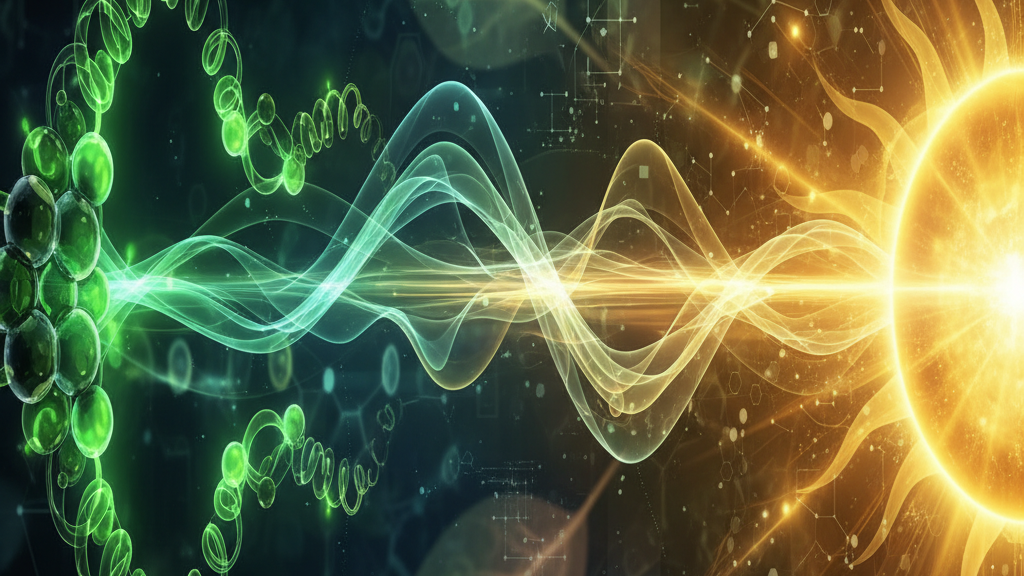
For most of the 20th century, the orthodox view of biology was that quantum mechanics, while obviously true, simply did not matter at the cellular scale. Cells were warm. Cells were wet. Quantum coherence — so the argument went — would be destroyed in femtoseconds by thermal noise long before it could influence anything biological.
Then, in 2007, Greg Engel, Graham Fleming, and colleagues published a paper in Nature showing that the photosynthetic light-harvesting complexes of green sulfur bacteria sustain quantum-coherent energy transport at biological temperatures, for hundreds of femtoseconds. That is long enough to matter — and it cleanly contradicted the textbook prior. The quantum-biology revolution started there.
What Photosynthesis Actually Does
When a photon hits a plant or photosynthetic bacterium, it is absorbed by a chromophore — typically a chlorophyll molecule — embedded in a protein scaffold called a light-harvesting complex. The energy then has to travel through a network of seven or so chromophores until it reaches the reaction center, where it is used to drive chemistry. The journey is short — a few nanometers — but it has to happen quickly, before the energy is lost as heat.
For a long time we assumed the energy "hopped" classically from chromophore to chromophore, like a marble down a slope, with each hop having some efficiency. The Fleming experiment showed something different: the energy travels as a delocalized quantum wave that simultaneously samples multiple paths through the complex, then "chooses" the most efficient one. This is quantum coherence doing useful work in a warm, wet biological system.
The Protein Scaffold Is the Key
The most important and underappreciated finding from the photosynthesis work is that the protein scaffold is not a passive holder for the chromophores. It is an active participant in maintaining coherence:
- Specific vibrational modes of the protein backbone match the energy gaps between chromophore states, supporting coherent transfer.
- The protein actively dampens decoherence-promoting fluctuations while preserving the slower, useful ones.
- The geometry of the protein positions chromophores at exactly the right distances and orientations for coherent coupling.
The lesson generalizes: biology can engineer environments that protect quantum coherence at temperatures and noise levels naive physics says are impossible. The decoherence objection is not wrong about the underlying physics; it is wrong about what biology can do with that physics.
The Microtubule Analogy
If you are looking for another protein structure with the right properties to maintain quantum coherence at body temperature, microtubules are an obvious candidate:
- They contain hydrophobic pockets — the same kind of environment that protects quantum states in photosynthetic proteins.
- Tubulin contains aromatic ring systems (tryptophan residues, phenylalanine) that can support exciton-like delocalized electronic states, similar to the chromophores in light-harvesting complexes.
- The microtubule lattice has a regular, repeating structure that creates well-defined vibrational modes — exactly the kind of structured environment that protects coherence in photosynthesis.
- They are surrounded by structured water that may add a further layer of shielding (see the EZ water account elsewhere in this series).
"The protein scaffold of photosynthetic complexes does not simply hold chromophores in place — it actively maintains quantum coherence through specific vibrational modes. This is a general design principle, not a special case. Any protein structure with the right geometry and the right vibrational spectrum could in principle do the same." — Engel et al., Nature, 2007
What This Means for Consciousness Research
Three concrete implications follow if you take the photosynthesis analogy seriously:
- The decoherence objection is weaker than it looks. "Quantum coherence at body temperature is impossible" was the strongest argument against Orch-OR. Photosynthesis demonstrates the impossibility was overstated. Microtubule coherence times do not need to be picoseconds to matter; they need to be long enough for the relevant biological process to use them, and biology has shown it can engineer that.
- The relevant frequency is set by structure. In photosynthesis, the protein vibrational modes that protect coherence have specific frequencies. In microtubules, those frequencies are calculable from the lattice geometry. The 8.085 MHz vibrational mode measured in single microtubules by Sahu and colleagues, with a quality factor of 1.7×10⁸, is exactly the kind of long-lived oscillation the photosynthesis analogy predicts.
- Quantum-enhanced biology may be widespread. If photosynthesis uses it and microtubules can support it, the next decade is likely to find quantum-coherent processes in many other systems: olfaction, magnetoreception, vision, possibly enzyme catalysis. Consciousness would not be an exception in a classical world; it would be one example of a broader pattern.
Permutations Worth Exploring
- What if microtubules evolved their hydrophobic pockets and aromatic residues precisely to host coherent electronic states, exactly the way photosynthetic proteins did — convergent evolution toward the same physical solution?
- What if neurodegenerative diseases that disrupt microtubule structure (Alzheimer's, FTD, ALS) are functionally analogous to a damaged light-harvesting complex — the chromophores are present, but the protein environment can no longer protect coherence?
- What if interventions that work for photosynthesis (specific vibrational drives, controlled solvent environments) could be adapted as therapies for microtubule-coherence loss?
The Larger Reframing
Quantum biology is no longer fringe. The work on photosynthesis has been replicated, extended, and accepted across the field. Olfactory tunneling, avian magnetoreception, and several other systems now sit alongside it. The relevant question for consciousness is no longer "could biology use quantum coherence at all?" — that has been answered. The question is whether the brain has done so, and the photosynthesis analogy gives us a concrete blueprint for how it might.
Further Reading
Engel G.S., Calhoun T.R., Read E.L., Ahn T.K., Mancal T., Cheng Y.C., Blankenship R.E. & Fleming G.R. (2007). Evidence for wavelike energy transfer through quantum coherence in photosynthetic systems. Nature, 446, 782–786. doi:10.1038/nature05678