The Diaphragm as a Vagal Organ: The Subdiaphragmatic Choke Point Nobody Examines
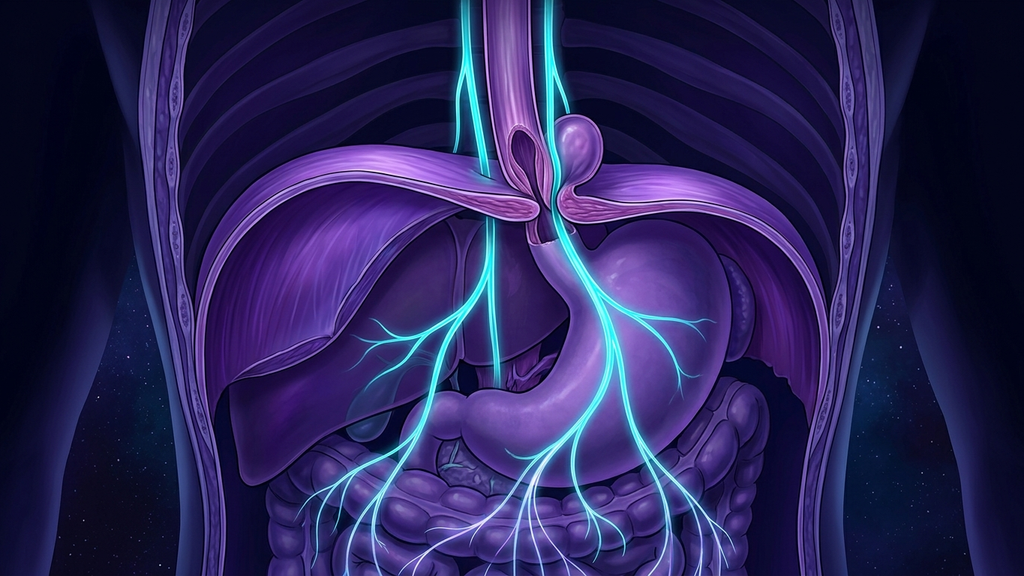
Most clinicians think of the diaphragm as a bellows and the vagus as a brain nerve, and never connect them. But the vagus does not float down into the abdomen — it is forced through a muscular slit in the diaphragm to reach the stomach, liver, and gut. That slit is a mechanical choke point at the exact border of chest and belly, and almost nobody examines it. When the diaphragm is tight or herniated, the subdiaphragmatic vagus is squeezed, and the fallout is digestive, metabolic, and autonomic all at once.
The Diaphragm Is a Vagal Organ
By the time the vagus (cranial nerve X) reaches the lower chest, its left and right branches have reorganized into two cords wrapped around the esophagus: the anterior and posterior vagal trunks (the consolidated vagus fibers that carry parasympathetic signals from the chest down into the abdomen). To get to the gut, both trunks must pass through the esophageal hiatus (the opening in the diaphragm through which the esophagus and vagus descend into the belly).
This is not a minor conduit. The vagus supplies parasympathetic control to the stomach, liver, pancreas, small intestine, and most of the colon, and roughly 80% of its fibers are afferent — sensory lines reporting the state of the gut back to the brain. The hiatus is the single doorway through which this entire gut-brain conversation must pass. That makes the diaphragm a de facto vagal organ, and the hiatus a bottleneck.
The Subdiaphragmatic Choke Point
Two common conditions squeeze the nerve at this doorway:
Diaphragmatic tension
A chronically tight, elevated, or splinted diaphragm — from shallow chest breathing, pain guarding, or postural collapse — keeps the muscular hiatus clenched around the esophagus and its vagal trunks. The nerve is not cut; it is chronically loaded, and chronic loading degrades signaling.
Hiatal hernia
A hiatal hernia (part of the stomach pushing up through the esophageal hiatus into the chest) mechanically distorts the hiatus and the vagal trunks that hug the esophagus there. Hiatal hernias are strikingly common — present in an estimated 15-20% of adults and far more prevalent with age, reaching well over half of adults past 50 in some series. Each one is a structural deformation at the precise level the vagus threads through, and yet the vagal consequence is almost never assessed.
Why the Downstream Effects Are Digestive and Metabolic
Because the subdiaphragmatic vagus governs the machinery of digestion and metabolism, compression at the hiatus shows up below it:
- Delayed gastric emptying — the vagus drives stomach motility; impaired signaling produces early fullness, bloating, reflux, and nausea, the clinical picture of sluggish or gastroparetic gut function.
- Metabolic dysregulation — vagal branches to the liver and pancreas influence insulin secretion, hepatic glucose handling, and satiety signaling. Blunted vagal tone is associated with poorer glycemic control and disordered appetite regulation.
- Gut-brain miscommunication — with roughly four-fifths of vagal fibers running afferent, a compressed hiatus garbles the interoception (the brain’s sensing of the body’s internal state) that normally reports gut status upward, feeding anxiety, poor appetite cueing, and the diffuse unwell feeling that has no test.
Breathing Is the Lever
The diaphragm-vagus relationship is not only a compression story — it is also the reason breathing changes autonomic state, and this is the most actionable part. Every breath moves the diaphragm across the vagal trunks that pass through it, and the respiratory rhythm modulates vagal outflow to the heart directly. This is measurable as respiratory sinus arrhythmia (the normal speeding of the heart on inhalation and slowing on exhalation, a direct readout of vagal tone).
The numbers are specific. Most people breathe at 12-20 breaths per minute; slow diaphragmatic breathing (deep breathing led by the diaphragm rather than the upper chest) at roughly 6 breaths per minute — around a 10-second cycle — sits at the resonance frequency of the human baroreflex. Breathing at that rate maximizes heart-rate variability and amplifies vagal afferent traffic, which is why slow diaphragmatic breathing measurably shifts the body toward a parasympathetic, recovery-dominant state. A mobile, well-excursing diaphragm both relieves mechanical load on the hiatus and pumps the afferent signaling that raises vagal tone. A clenched one does the opposite on both counts.
The Choke Point Nobody Examines
Here is the gap. A patient with reflux, bloating, blood-sugar swings, and low-grade autonomic symptoms is worked up organ by organ — a gastric study here, a glucose panel there — while the one structure that connects all of them, the vagus at the diaphragmatic hiatus, is never assessed as a mechanical unit. The subdiaphragmatic choke point falls between specialties: the gastroenterologist sees the hernia but not the nerve, and the neurologist sees the vagus but not the diaphragm.
What This Means for Practitioners
- Treat the diaphragm as neuroanatomy, not just a muscle. When digestive, metabolic, and autonomic symptoms cluster, consider that they may share one compression site at the hiatus.
- Ask about the hernia’s nerve. A known hiatal hernia is not only a reflux issue; it is a structural deformation at the vagal doorway and may explain motility and autonomic complaints.
- Prescribe slow diaphragmatic breathing on mechanism. Around 6 breaths per minute mobilizes the diaphragm and drives vagal afferent signaling; the benefit is physiological, not merely relaxation.
- Look above and below together. The subdiaphragmatic vagus links the gut, the liver, and the pancreas to the brain through one slit — the most efficient place to intervene is the choke point they share.
The diaphragm is the last gate the vagus passes before it reaches the gut, and it is the one nobody examines. Tension and herniation squeeze the nerve at the border of chest and belly; slow breathing releases it and floods the brain with vagal signal. Name the subdiaphragmatic choke point, and reflux, blood sugar, and calm stop looking like three problems and start looking like one.
Reference: Frontiers in Psychiatry, respiratory vagal tone and slow breathing (2021).