Cymatics, Resonance, and Microtubule Geometry — Sound Shapes Consciousness
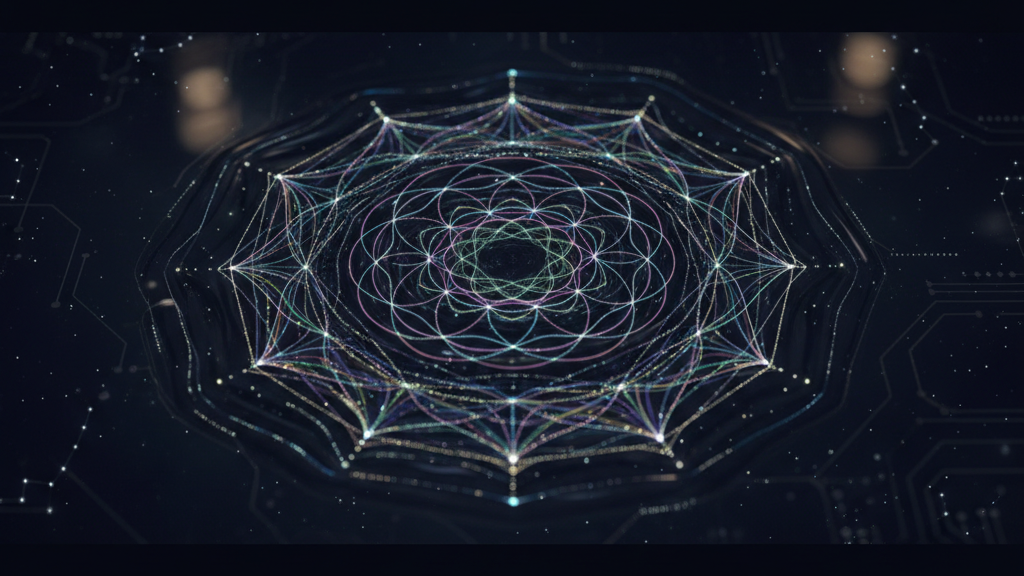
Pour fine sand on a metal plate and bow its edge, and the sand arranges itself into geometric patterns that depend on the bow's frequency. Change the frequency and the pattern changes. The patterns are not aesthetic curiosities — they are direct visual manifestations of the standing-wave modes of the plate. This is cymatics, formalized by Hans Jenny in the 1960s but documented in primitive form for centuries.
The cymatics insight is simple and general: sound, applied to a structured medium, organizes that medium into geometry that depends on frequency. The implications for biology are not. If the brain contains structured media — and it does, abundantly — then sound delivered at the right frequency should organize them, too. The most interesting candidate substrate is the microtubule lattice.
Why Microtubule Geometry Matters
Microtubules are not amorphous. Each one is a precisely specified geometric object: 25 nanometers in outer diameter, 15 nanometers inner diameter, built from 13 protofilaments running parallel along the length, with tubulin dimers spaced 8 nanometers apart along each protofilament. The lattice as a whole has a slight helical pitch.
This precise geometry sets specific resonance frequencies. The smallest dimensions — single tubulin dimers — resonate in the terahertz range, well above any acoustic stimulus. But larger structural features resonate at lower frequencies:
- Individual microtubule lengths: kilohertz to megahertz
- Bundles of axially aligned microtubules in axons: hundreds of hertz to kilohertz
- Whole nerve fascicles (e.g., in the vagus): tens to hundreds of hertz, well within the auditory range
This means that different acoustic frequencies couple selectively to different scales of microtubule organization. Low frequencies engage whole-nerve resonances; mid frequencies engage individual axons; ultrasound at megahertz frequencies engages individual microtubules.
The Sahu Measurement
The most striking experimental support for microtubule resonance comes from Sahu, Bandyopadhyay, and colleagues, who measured vibrational modes in single microtubules at biological temperatures. Their finding: a vibrational mode at 8.085 MHz with a quality factor of approximately 1.7 × 10⁸. For context, that quality factor is comparable to the best engineered macroscopic resonators and many orders of magnitude higher than expected for a "warm and wet" biological structure.
A high quality factor means the resonance is sharp — the mode rings strongly at its specific frequency and damps quickly at others. Drive the microtubule at exactly 8.085 MHz and you couple efficiently into the structure. Drive it slightly off-frequency and the energy bounces away. This is the prediction cymatics makes for biology, and it has now been measured directly.
"Vibrational modes in single microtubules show extremely high quality factors at biological temperature, suggesting these structures behave as precision-tuned resonators rather than as the disordered, dissipative environments biology is usually assumed to provide." — Sahu et al., Nano Letters, 2013
What This Means for Sound-Based Practice
The cymatics-microtubule picture provides a possible mechanism for many sound practices that have been passed down empirically for millennia:
- Mantra and chanting traditions. Specific syllables produce specific acoustic spectra. Traditions that converged on particular phonemes — Sanskrit mantras, Tibetan throat singing, Sufi chant — may have empirically discovered frequency combinations that engage microtubule resonances productively.
- Singing bowls and gongs. These instruments produce sustained tones rich in inharmonic overtones. The resulting acoustic field engages many resonant modes simultaneously, possibly explaining the deep relaxation and altered states they reliably produce.
- Binaural beats. When two slightly different frequencies are presented to the two ears, the brain produces a perceived "beat" at the difference frequency. Binaural beats may work not by directly stimulating the brain at the difference frequency but by creating an interference pattern that resonates with microtubule structures.
- Therapeutic ultrasound. Modern transcranial ultrasound and ultrasonic vagal stimulation appear to work best at specific narrow frequency ranges. The cymatics framing predicts these should correspond to structural resonances of the target tissue's microtubule organization.
Designing "Quantum Cymatics"
If microtubules are precision resonators with well-defined modes, it should be possible to design therapeutic acoustic interventions matched to specific tissue types and clinical goals. This is the most ambitious version of the cymatics-microtubule program:
- Map the dominant microtubule organization for each target tissue (cortical neurons, vagal afferents, cardiac conduction tissue, etc.)
- Calculate the corresponding resonance frequencies
- Develop ultrasound or audio protocols that drive those frequencies cleanly
- Validate clinical effects in disorders linked to microtubule dysfunction
Some of this is already happening informally. Many modern ultrasound neuromodulation devices use frequency parameters that were chosen empirically — they happen to work. The cymatics frame predicts those empirical frequencies should be calculable from the underlying microtubule geometry. If they turn out to match, that is a significant indirect confirmation.
Permutations Worth Exploring
- What if the specific frequencies used by ancient sound traditions (Solfeggio, Pythagorean tuning, Indian shrutis) are not arbitrary cultural choices but converged-upon resonances with biological structure?
- What if individual variation in response to sound therapy reflects individual variation in microtubule organization — making "personalized cymatic medicine" a coherent goal?
- What if the long-noted effect of music on emotion has a substrate-level explanation: certain harmonic combinations resonate with structures involved in emotional processing, not just trigger conditioned associations?
- What if the integration of sound, breath, and movement in many contemplative traditions is doing exactly what we would predict — engaging mechanical, chemical, and acoustic levers on the same cytoskeletal substrate?
Honest Limits
The cymatics-microtubule program is at the intersection of well-established physics (cymatics, structural resonance), well-established biology (microtubule architecture), and contested theory (microtubule quantum coherence, Orch-OR). The first two halves are solid. The third remains open. But you do not need the strong quantum claim to take the cymatics half seriously: even purely classical resonance with microtubule lattices would predict many of the observed effects of sound-based intervention. The quantum extension is an additional claim, not a prerequisite.
Further Reading
Jenny H. (1967). Cymatics: A Study of Wave Phenomena and Vibration. Macromedia Publishing (revised 2001). cymaticsource.com