Consciousness Engineering with Ultrasound
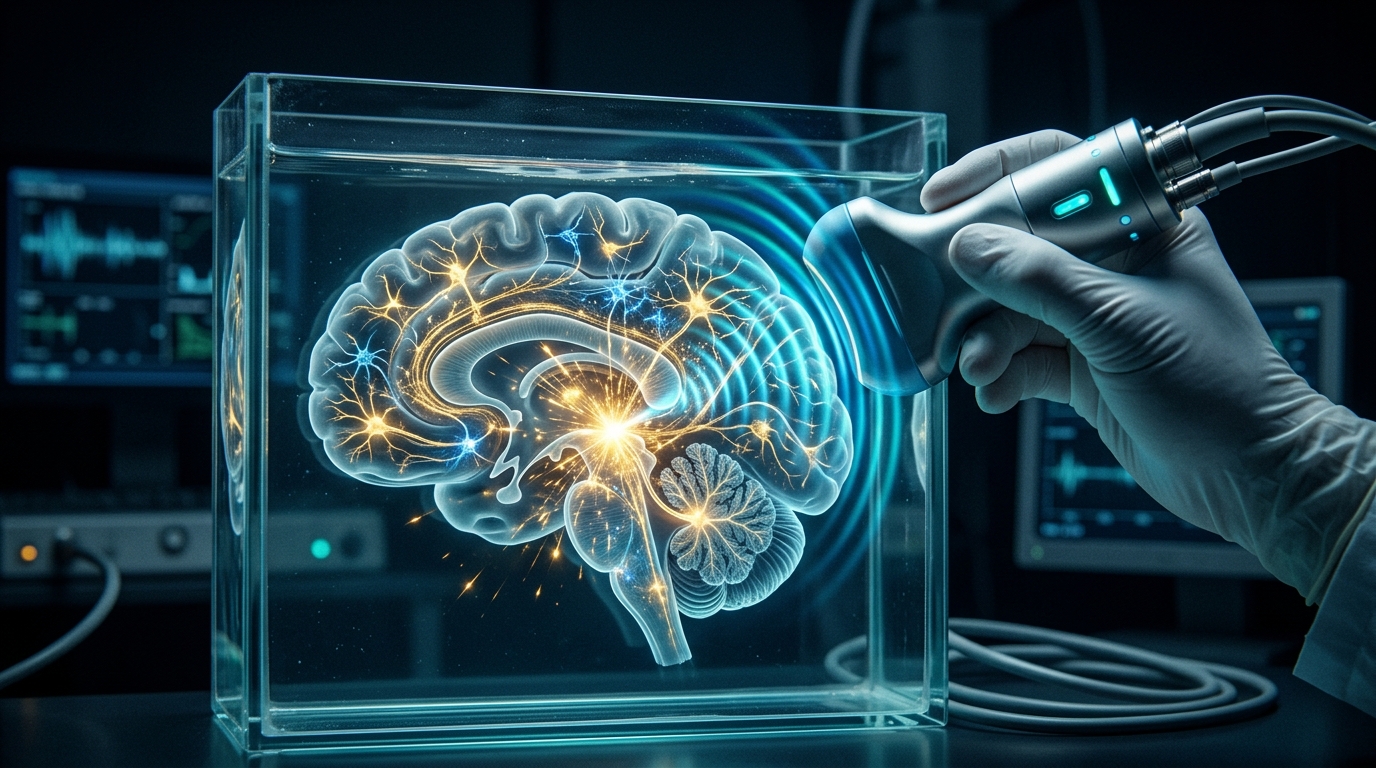
For most of medical history, reaching a specific brain region meant either invasive surgery or very imprecise drugs. Transcranial magnetic stimulation (TMS) helped, but it cannot reach beyond the cortical surface. Today, low-intensity focused ultrasound (LIFU) is changing that picture entirely. Ultrasound passes through the skull, focuses to a millimeter-scale spot, and modulates neural activity without damaging tissue. For the first time, we can reach the thalamus, the claustrum, and the brainstem nuclei with precision — and the implications for consciousness research are enormous.
Why Ultrasound Is Different
Electrical stimulation, magnetic fields, and pharmacology all share a fundamental limitation: they cannot reach a small target deep in the brain without affecting everything between the surface and the target. Ultrasound is a mechanical wave that can be focused — much like sunlight through a magnifying glass — to deliver energy precisely where you want it, and almost nowhere else.
The therapeutic window for neuromodulation is roughly 0.25–0.7 MHz at intensities well below those used for tissue heating. At these parameters, ultrasound:
- Modulates the firing rate of neurons within the focal volume, either up or down depending on pulse parameters
- Activates mechanosensitive ion channels (Piezo1, Piezo2, TRP family) directly through pressure
- Briefly opens the blood-brain barrier when paired with circulating microbubbles, enabling targeted drug delivery
- Produces effects that fade within minutes to hours, leaving no permanent change in the tissue
The Consciousness Network
Decades of clinical work — from anesthesia to coma research to deep-brain stimulation — have converged on a small set of structures that appear to gate conscious awareness. Focused ultrasound now lets researchers test each of them non-invasively.
The Thalamus
The thalamus is the brain's central relay. Almost every cortical region exchanges information with it, and disorders of consciousness almost always involve thalamic dysfunction. In a landmark 2016 case, Monti and colleagues at UCLA used focused ultrasound on the thalamus of a patient in a minimally conscious state. The patient's level of responsiveness improved within days. The result has since been replicated and extended.
The Default Mode Network
The DMN — a network including the medial prefrontal cortex, posterior cingulate, and angular gyri — is most active during rest, mind-wandering, and self-referential thought. Down-regulating the DMN is a consistent neural signature of deep meditation and of psychedelic experience. Ultrasound modulation of DMN hubs can transiently produce similar phenomenological shifts: ego dissolution, openness, a sense of stillness behind thought.
The Claustrum
The claustrum is a thin sheet of neurons buried beneath the cortex, with connections to nearly every other brain region. Francis Crick spent his final years arguing that the claustrum acts as a "conductor" — binding distributed neural activity into the unified field of conscious experience. Direct stimulation experiments suggest he may have been right: brief electrical pulses to the claustrum can reversibly suspend awareness. Ultrasound now allows that hypothesis to be tested without electrodes.
"Ultrasound has finally given consciousness research what optogenetics gave neuroscience: a precise, reversible, causal tool. The next decade is going to look very different from the last one." — Frontiers in Human Neuroscience, 2025
Combining Ultrasound with Inner Practice
The most interesting work happening in this space isn't ultrasound used as a standalone clinical intervention — it's ultrasound paired with intentional practice. Combining a 5-minute LIFU session targeting the DMN with a guided meditation appears to lower the energetic threshold for entering a deep meditative state, much the way light therapy lowers the threshold for circadian entrainment.
Use cases under active investigation include:
- Accelerating learning by pairing LIFU of the basal forebrain with skill practice
- Treatment-resistant depression via subgenual cingulate modulation
- Somatic trauma processing via insula and amygdala targeting
- Enhancing the depth and reliability of breathwork-induced altered states
What's Coming Next
Hardware costs are falling rapidly. Wearable transcranial ultrasound caps with embedded MRI-derived focal targeting are already in early clinical trials. Within a few years, the same kind of consumer-grade form factor that took heart-rate variability mainstream is likely to do the same for targeted brain stimulation.
That raises real ethical questions. Tools powerful enough to modulate consciousness reliably are also powerful enough to misuse. UltraSkool's training emphasizes one principle above all: ultrasound is a multiplier, not a substitute. It amplifies whatever practice and intention you bring to it. The tool is finally arriving. The work of becoming someone worth amplifying remains exactly the same.