Ultra Breath: Awakening Your Microtubules
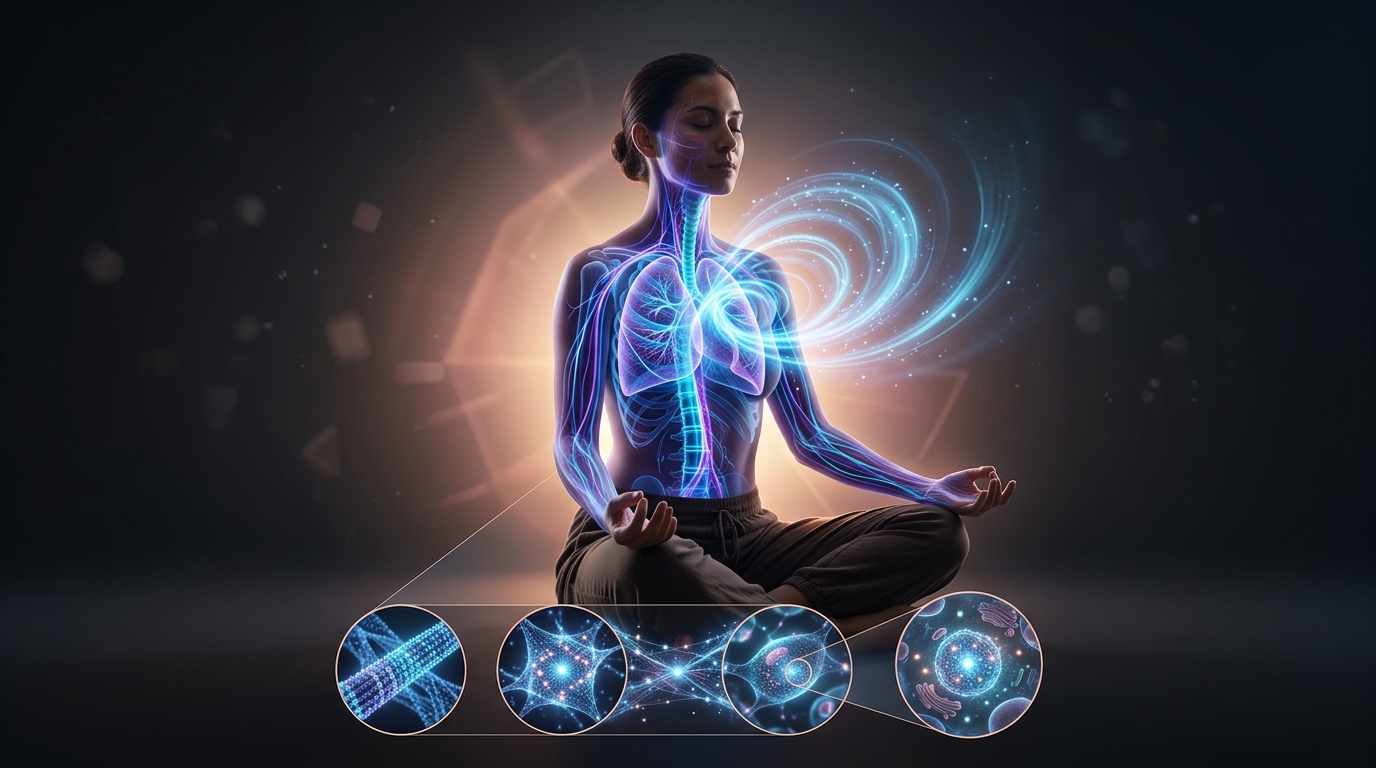
Deep within every cell of your body lies a vast, hollow lattice of microtubules — protein polymers that form the cytoskeleton, transport cargo, and organize cell division. For most of the 20th century, microtubules were considered structural scaffolding. Today, a growing body of biophysics research suggests they may be far more: dynamic, electromagnetically active, and possibly the physical substrate where the brain crosses from chemistry into experience.
The Ultra Breath technique is built around a simple proposition: if microtubules are the cellular instrument of consciousness, then a breath practice that mechanically, chemically, and electromagnetically engages them should produce reliably altered states. The protocol pairs controlled hyperventilation, breath retention, and rhythmic patterning with intentional attention — and the experiences that emerge are remarkably consistent across practitioners.
Why Microtubules?
Each tubulin dimer in a microtubule can sit in two slightly different conformations. Stack 13 of these dimers around a hollow cylinder, repeat thousands of times along a neuronal dendrite, and you have a structure capable of storing, propagating, and possibly computing information at a scale and density that classical neural network models simply do not capture.
Microtubules are also piezoelectric: mechanical pressure produces voltage, and voltage produces mechanical motion. They oscillate at frequencies ranging from kilohertz to terahertz, and they are surrounded by ordered "exclusion zone" water that may shield them from thermal noise long enough for quantum-scale events to influence their state. None of this is hypothetical — these properties have all been measured directly in vitro.
How Ultra Breath Engages the System
Ultra Breath works through four overlapping mechanisms, each grounded in a specific biological pathway:
- Mechanical pressure waves. Deep diaphragmatic breathing creates rhythmic intra-thoracic pressure changes that transmit through fascia, vasculature, and cerebrospinal fluid. These waves mechanically perturb microtubule arrays in glial cells and neurons, exciting their natural resonance modes.
- Chemical modulation. Controlled hyperventilation lowers CO₂ and produces a transient respiratory alkalosis. This shifts intracellular pH, affecting tubulin polymerization rates and the binding of microtubule-associated proteins (MAPs) such as tau.
- Electromagnetic coupling. The heart and brain together produce a measurable biofield. Slow, rhythmic breathing entrains heart rate variability (HRV), strengthening the coherent component of this field — and microtubules, being electrically active, are sensitive to coherent electromagnetic input.
- Vagal tone. The vagus nerve is densely populated with microtubule-rich axons. Strong, slow exhales increase parasympathetic tone, raising baseline vagal output and bathing peripheral microtubule networks in steady neuromodulatory signals.
What Practitioners Report
The phenomenology of Ultra Breath sessions is strikingly stable across very different participants — meditators, athletes, clinical patients, first-timers. Common reports include:
- Geometric visual phenomena, often described as crystalline lattices or rotating tori
- Time dilation: a 25-minute session subjectively feeling like an hour or longer
- Emotional release without obvious cognitive content — tears or laughter that "arrive without a story"
- Sharp post-session clarity and an unusual ease in language production
- Physical sensations of warmth or vibration localized to the limbs and face
"The interesting thing isn't that breathwork can produce altered states — that's been known for thousands of years. The interesting thing is how reliably it produces the same altered states across people who share no cultural framework for them." — Ultra Skool training notes, 2026
The Orch-OR Connection
The most ambitious account of why all this matters comes from Roger Penrose and Stuart Hameroff's Orchestrated Objective Reduction (Orch-OR) theory. Orch-OR proposes that consciousness arises from quantum-state collapses inside microtubules, "orchestrated" by the surrounding neural environment. Each collapse event is a discrete moment of experience.
If Orch-OR is even directionally correct, then any intervention that increases the rate, coherence, or coupling of these events should produce richer subjective experience. Breathwork — with its long history of inducing precisely such states — becomes a candidate first-line technology for influencing the substrate Orch-OR points to.
Practicing Safely
Ultra Breath is a strong practice. Hyperventilation followed by breath retention can cause lightheadedness, tetany, and (rarely) loss of consciousness. Practice on a soft surface, never in water, and never while operating machinery. People with cardiovascular conditions, epilepsy, or pregnancy should consult a clinician before starting.
Used carefully and consistently, Ultra Breath becomes a daily lever on the cellular machinery of attention, mood, and awareness. The tools are old. The understanding of why they work is brand new.