Chronic Pain and Central Sensitization: Calming an Over-Tuned Nervous System
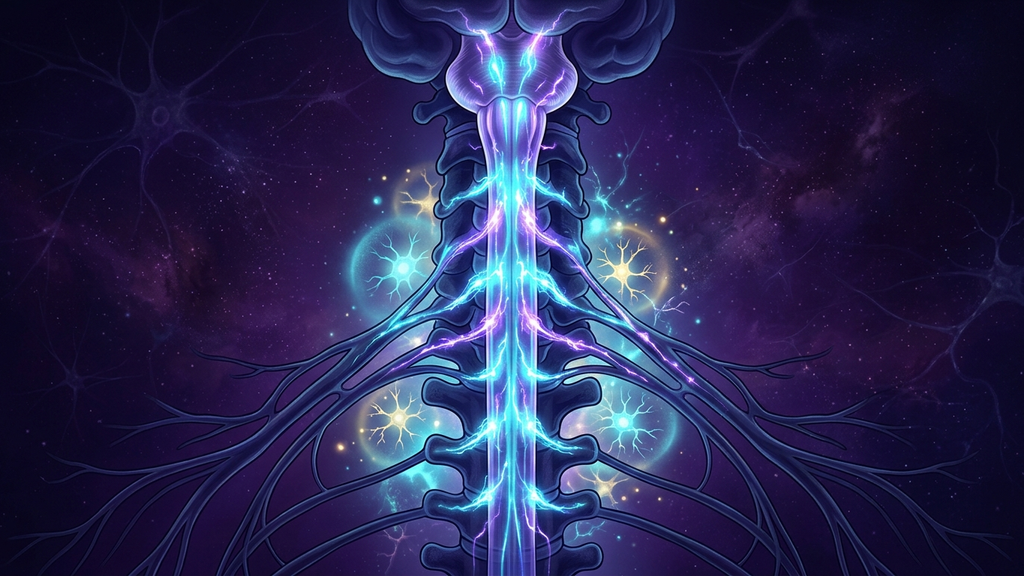
A patient comes in with seven years of widespread pain. Imaging is unremarkable. Inflammatory markers are normal or borderline. Five practitioners have told her it is "in her head." The pain is real, the workup is clean, and standard analgesics have stopped working. This is the typical presentation of central sensitization — a state in which the nervous system has become so amplified that ordinary stimuli register as pain.
What Central Sensitization Actually Is
Central sensitization is increased responsiveness of nociceptive neurons in the central nervous system to normal or subthreshold input. The mechanisms are well characterized: enhanced glutamatergic signaling at NMDA receptors, loss of inhibitory GABAergic and glycinergic tone, and activation of microglia and astrocytes in the spinal cord and brain. The result is that the volume knob on the pain system has been turned up — and the system stops responding to ordinary peripheral interventions.
Neuroinflammation Is the Driver
The 2025 literature is increasingly clear: chronic widespread pain is maintained by neuroinflammation. Microglia release pro-inflammatory cytokines that lower the firing threshold of dorsal horn neurons. Astrocytes contribute to long-term potentiation in pain pathways. The peripheral tissue may have healed, but the spinal cord and brain are still talking pain.
The Vagus Nerve as Anti-Inflammatory Lever
Here is the clinically interesting part. The vagus nerve, through the cholinergic anti-inflammatory pathway, actively suppresses systemic and neural inflammation. When vagal tone collapses — as it does in most chronic pain populations — this brake fails. A 2025 pilot of auricular vagal neuromodulation in fibromyalgia patients showed significant improvements in symptom severity and sleep over four weeks of 30-minute daily sessions. The mechanism is not analgesia in the conventional sense. It is normalization of the inflammatory state in which pain signals are being amplified.
The Treatment Framework
I structure intervention around three goals: lowering neural inflammation, restoring inhibitory tone, and retraining the autonomic baseline.
1. Lower Neuroinflammation
- Omega-3 (EPA 2–3 g/day) — reduces microglial activation.
- Low-dose naltrexone (1.5–4.5 mg nightly) — modulates microglial TLR4 signaling.
- Investigate and treat gut-derived inflammation — leaky gut and dysbiosis raise systemic inflammatory load.
2. Restore Inhibitory Tone
- Magnesium glycinate — NMDA antagonist activity.
- Glycine 3 g at bedtime — direct GABA-receptor support.
- Sleep optimization — slow-wave sleep restores spinal inhibition.
3. Retrain the Autonomic Baseline
- HRV biofeedback or transcutaneous auricular vagus nerve stimulation, daily.
- Graded exposure to gentle movement — Zone-1 walking, swimming, or stationary cycling at conversational intensity. Avoid the post-exertional-flare trap by underdosing.
- Pain neuroscience education — the patient must understand that pain volume is being amplified centrally, or no peripheral intervention will hold.
Why Stronger Painkillers Stop Working
Opioids and even gabapentinoids paradoxically worsen central sensitization over time. Opioid-induced hyperalgesia is well documented; chronic opioid use upregulates spinal NMDA signaling and microglial activation — the very mechanisms driving the original pain amplification. The dose escalates because the system is becoming more, not less, sensitized.
The New-Medicine Angle
Bioelectronic medicine — taVNS, focused ultrasound applied to deep brain pain matrices, and PEMF — is converging with the central sensitization model because all three intervene on the network state rather than the peripheral signal. The clinical question is no longer "where does it hurt?" but "what is the state of the system that is generating the pain signal?"
Clinical takeaway: Once chronic pain has centralized, peripheral interventions reach their ceiling. Treat the inflammatory state of the nervous system, restore inhibitory tone, and retrain the autonomic baseline. The pain dial turns down when the network state changes.
References
- Ji RR et al. "Neuroinflammation and central sensitization in chronic and widespread pain." Anesthesiology, 2018;129(2):343-366.
- Kerckhove N et al. "Potential of vagus nerve stimulation to modulate fibromyalgia's network physiology: a systematic review." Journal of Functional Morphology and Kinesiology, 2025;11(1):15.
- Wolfe F et al. "Fibromyalgia criteria and severity scales for clinical and epidemiological studies." Journal of Rheumatology, 2011;38(6):1113-1122.
- Tracey KJ. "The inflammatory reflex." Nature, 2002;420:853-859.
- Frangos E et al. "Non-invasive access to the vagus nerve central projections via auricular stimulation." Brain Stimulation, 2015;8(3):624-636.