The Cholinergic Anti-Inflammatory Pathway: The Vagus–Immune Link
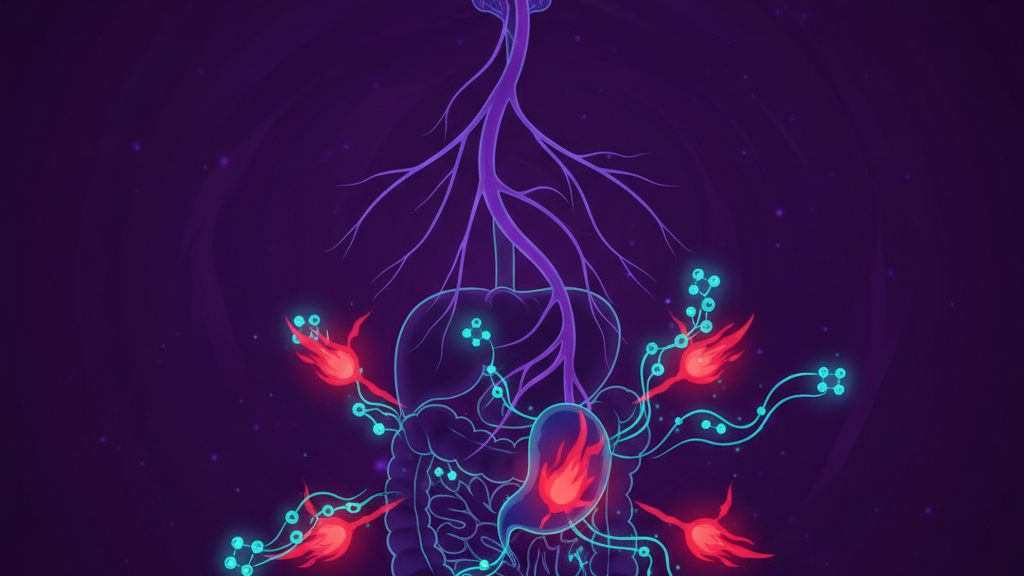
In 2000, Kevin Tracey and colleagues published a paper that quietly reshaped immunology. They showed that stimulating the vagus nerve in animals reduced systemic inflammation — and that the effect required acetylcholine acting on alpha-7 nicotinic receptors on macrophages. They named it the cholinergic anti-inflammatory pathway. Two decades later, this finding is the foundation of the entire bioelectronic medicine field.
The Mechanism
The efferent vagus nerve releases acetylcholine. Acetylcholine binds alpha-7 nicotinic receptors (α7nAChR) on splenic macrophages and other immune cells. This binding suppresses NF-κB signaling and reduces production of inflammatory cytokines including TNF, IL-1, IL-6, and HMGB1. The effect is rapid, specific, and clinically meaningful.
Why This Matters
Chronic, low-grade inflammation is a driver of nearly every modern disease — cardiovascular disease, neurodegeneration, autoimmunity, cancer, depression, metabolic disease. The cholinergic anti-inflammatory pathway is the body's built-in brake on this process. When vagal tone is reduced, the brake is weak, and inflammation runs unchecked.
Conditions Where This Pathway Is Clinically Relevant
- Rheumatoid arthritis (clinical trials of implanted vagus stimulators in progress)
- Inflammatory bowel disease
- Sepsis (the original animal models)
- Chronic pain syndromes with inflammatory components
- Postoperative ileus
- Hashimoto's and other autoimmune conditions
- Long-COVID and post-viral inflammatory states
How to Engage the Pathway
Behavioral and Physiological
- Slow nasal breathing, particularly with extended exhalation
- Cold-water face immersion (mammalian dive reflex strongly activates vagal output)
- Humming, singing, gargling — all engage vagal motor pathways
- Chronic exercise — improves baseline vagal tone
Bioelectronic
- Implanted vagus nerve stimulators (FDA-cleared for epilepsy and depression)
- Transcutaneous auricular vagus nerve stimulation (consumer devices available)
- Transcutaneous cervical vagus stimulation (FDA-cleared for migraine and cluster headache)
- Focused ultrasound to the cervical vagus — emerging non-invasive option
Pharmacologic
α7nAChR agonists are in development. Existing partial agonists like varenicline have anti-inflammatory effects.
The Cellular Lens
What makes this pathway elegant is that it does not require introducing a new chemical. The body is already manufacturing acetylcholine. The intervention is to engage a circuit that exists, at the cellular level, to do exactly what we are trying to accomplish. This is the spirit of new medicine: support the cell to do what it is already trying to do.
Clinical takeaway: If a patient has a chronic inflammatory or autoimmune process and reduced vagal tone, engaging the cholinergic anti-inflammatory pathway is not adjunct care. It is core care.
References
- Borovikova LV et al. "Vagus nerve stimulation attenuates the systemic inflammatory response to endotoxin." Nature, 2000;405(6785):458-462.
- Tracey KJ. "The inflammatory reflex." Nature, 2002;420(6917):853-859.
- Koopman FA et al. "Vagus nerve stimulation inhibits cytokine production and attenuates disease severity in rheumatoid arthritis." PNAS, 2016;113(29):8284-8289.