Anesthetic Gases — The Quantum Test for Consciousness
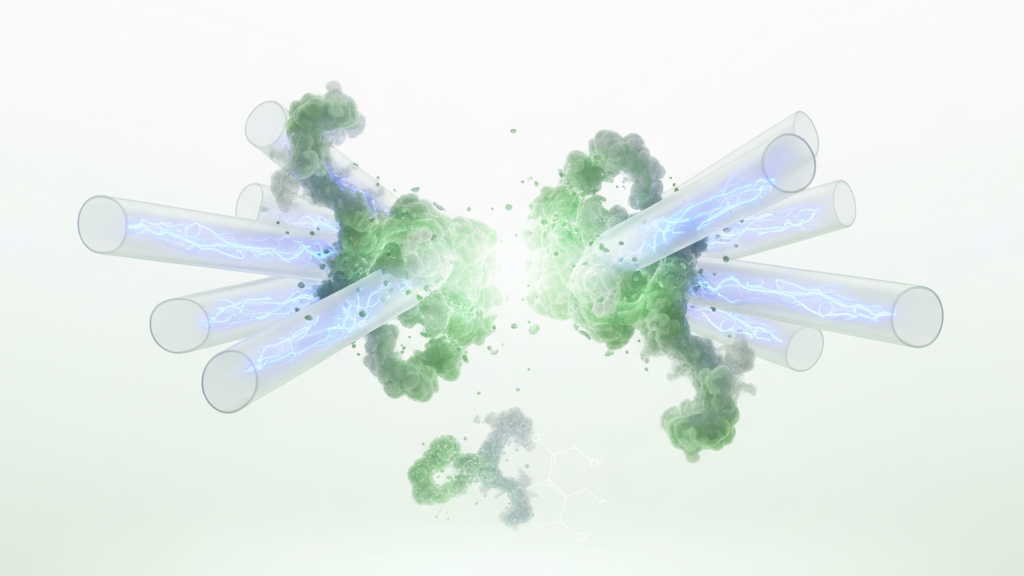
General anesthesia is one of the most extraordinary technologies in modern medicine. We administer a chemical, the patient loses consciousness, surgery is performed, the chemical wears off, the patient returns. We have been doing this routinely for over 150 years, on tens of millions of people per year, with refined dosing protocols and excellent safety. And we still cannot fully explain how it works.
The puzzle is not that anesthetics affect the brain — many drugs do. The puzzle is that so many chemically different molecules all produce the same specific effect: a clean, reversible, dose-dependent loss of consciousness, with most other neural activity continuing uninterrupted. Whatever consciousness is, anesthesia is its precise off switch. Reverse-engineering that switch is one of the cleanest paths into the underlying physics.
The Meyer-Overton Correlation
The earliest empirical regularity, discovered independently by Hans Meyer and Charles Ernest Overton at the turn of the 20th century, is that anesthetic potency tracks lipid solubility. The more lipid-soluble a molecule is, the smaller the dose required to produce anesthesia. This relationship spans five orders of magnitude and includes molecules as different as ether, halothane, propofol, and the noble gas xenon.
The classical interpretation: anesthetics dissolve into the lipid membranes of neurons and disrupt membrane function generically. This was the consensus for nearly a century. It has two serious problems.
Two Cracks in the Membrane Theory
First, non-anesthetic gases exist that should be anesthetic and aren't. Cutting-edge experiments in the 1990s identified compounds with the "right" lipid solubility that nevertheless fail to produce anesthesia at predicted doses. If lipid solubility were the whole story, this would not happen. Some other property is doing the actual work.
Second, anesthetics bind to specific protein targets, not just lipid membranes. Detailed structural studies have shown that volatile anesthetics, intravenous anesthetics, and even xenon all interact with hydrophobic pockets in specific proteins. One target stands out across this otherwise diverse pharmacology: tubulin, the protein subunit of microtubules.
Anesthetics, Tubulin, and Quantum Coherence
Hameroff's longstanding argument is that the common mechanism of all general anesthetics is disruption of microtubule dynamics, specifically of any quantum-coherent activity hosted there. The evidence is now substantial:
- Volatile anesthetics bind directly to hydrophobic pockets in tubulin, in regions known to be involved in protein-protein contacts within the microtubule lattice.
- Anesthetic exposure measurably alters tubulin's conformational dynamics and reduces the duration of correlated electrical fluctuations along microtubules.
- Xenon — a noble gas with no hydrogen bonding, no obvious membrane chemistry, and no specific receptor — produces clean anesthesia. Its only credible target is the kind of dispersion-force interaction it can have with tubulin's hydrophobic core.
- Anesthetics suppress 40 Hz gamma oscillations more reliably than they suppress overall neural activity. Gamma is the macroscopic readout of consciousness; suppressing it specifically is exactly what targeting microtubule coherence would do.
"The common underlying mechanism of all general anesthetics is most likely the disruption of quantum coherence in neuronal microtubules — a hypothesis that uniquely accounts for both the Meyer-Overton correlation and the existence of non-anesthetic gas pairs." — Hameroff, Anesthesiology, 2006
The Quantum Test
This is the closest thing consciousness research has to a clean experiment. Compare two molecules with nearly identical physical properties — same lipid solubility, same molecular size, same general structure — but where one is anesthetic and one is not. The "non-anesthetic gas pairs" provide exactly this control.
If the membrane theory is right, the difference between members of a pair should be invisible at the molecular target level. If the quantum-coherence theory is right, only the anesthetic member should disrupt measurable quantum coherence in tubulin. Several labs are working toward this measurement directly. A clean negative result would significantly undermine Orch-OR. A clean positive result would be one of the most important findings in modern neuroscience.
Permutations Worth Holding
- If anesthesia is quantum decoherence, then partial anesthesia should produce subjectively distinctive states — not just dimmer awareness but qualitatively altered experience. Patients report exactly this in twilight sedation.
- If quantum coherence is graded rather than binary, then "depth of anesthesia" is not just a clinical convenience — it is a real physical quantity, and bispectral index monitors are tracking something fundamental rather than empirical.
- If xenon works through dispersion-force coupling at tubulin, it should be possible to design anesthetics with extreme selectivity — minimal cardiac, respiratory, or motor side effects, leaving only the conscious-state switch. Xenon already approaches this profile clinically.
- If anesthesia disrupts EZ-water shielding around microtubules rather than tubulin directly, the same predictions follow but the molecular target is different. This is testable.
Why This Matters Beyond Anesthesia
Anesthetics are the only intervention we have that selectively, reversibly, and reliably abolishes consciousness without abolishing life. Whatever anesthetics do at the molecular level is the molecular signature of the consciousness switch. Understanding that mechanism is not just a clinical refinement — it is a direct path into one of the deepest questions in science.
Decades of research have narrowed the candidate mechanisms dramatically. The remaining short list runs through microtubules. The next round of experiments may finally close the question.
Further Reading
Hameroff S. (2006). The entwined mysteries of anesthesia and consciousness: Is there a common underlying mechanism? Anesthesiology, 105(2), 282–284. doi:10.1097/00000542-200609000-00025