Wound Healing as a Bioenergetic Process: Ultrasound, Light, and the Cellular Repair Cascade
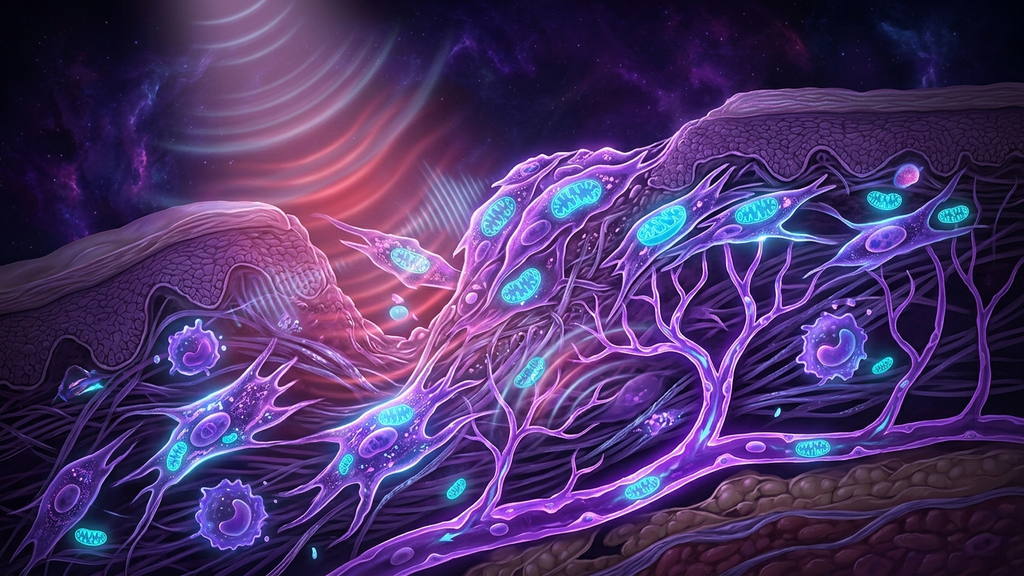
When a wound heals, you are watching one of the most coordinated biological events the body is capable of. Within minutes, platelets aggregate and release growth factors. Within hours, neutrophils and macrophages arrive to debride. Within days, fibroblasts begin laying down collagen scaffolding. Within weeks, new capillaries form and re-epithelialization closes the surface. Within months, the new tissue remodels toward its final tensile strength. The entire process is choreographed and astonishingly energy-expensive.
When that energy is unavailable, healing stalls. And in modern clinical practice — diabetes, aging, post-surgical wounds, chronic non-healing ulcers — stalled healing is increasingly common. The reframe that changes the treatment plan: wound healing is, at its core, a bioenergetic process.
What Healing Actually Costs
Healing tissue has ATP demand several-fold higher than resting tissue. Three reasons:
- Cellular proliferation requires nucleotide synthesis, which is ATP-intensive.
- Collagen synthesis requires hydroxylation reactions that consume oxygen, iron, vitamin C, and reducing power.
- Angiogenesis — the growth of new capillaries — is among the most metabolically expensive tissue-level processes the body performs.
If the systemic energy budget cannot support this surge, healing slows, stops, or proceeds with poor-quality output. The clinical signature: wounds that close but with thin, fragile scars; surgical sites that develop dehiscence; ulcers that re-open at the slightest pressure.
The Common Causes of Bioenergetic Healing Failure
- Diabetes and insulin resistance. Glucose handling is impaired, capillary perfusion is compromised, and mitochondrial function in the wound bed is reduced.
- Chronic infection or inflammation consumes substrate that would otherwise go to tissue repair.
- Aging. Mitochondrial density and quality decline with age, especially in the skin.
- Steroid therapy directly inhibits fibroblast function and collagen synthesis.
- Smoking and vaping impair capillary perfusion and oxygenation at the wound bed.
- Micronutrient deficiencies — particularly zinc, vitamin C, vitamin D, iron, and protein — limit the substrate available for new tissue construction.
- Chronic sympathetic dominance redirects blood flow away from skin and toward core organs and muscles.
The Standard-Care Foundation
Before the new-medicine tools earn a place, the basics have to be in order: moist wound environment, infection control, adequate nutrition (especially protein and zinc), tight glycemic control where relevant, and offloading of any pressure source. These remain the highest-yield interventions and most chronic non-healing wounds will respond to them when applied consistently.
Where Physical-Medicine Modalities Earn Their Place
Three physical-medicine tools have substantial mechanistic and clinical evidence in wound healing, and they are starting to be combined deliberately rather than in isolation.
1. Therapeutic Ultrasound
Low-intensity pulsed ultrasound (LIPUS) delivered at 1-3 MHz has been studied for decades in chronic wounds, fracture healing, and tendon repair. The mechanism is partly mechanotransductive — pressure waves modulate ion channel kinetics in fibroblasts and stimulate growth factor release — and partly thermal, with a small but biologically meaningful increase in local tissue temperature improving perfusion. The clinical signal is strongest in venous stasis ulcers and in fracture healing, where LIPUS is FDA-cleared.
2. Photobiomodulation (Red and Near-Infrared Light)
Red light at roughly 630–680 nm and near-infrared at 810–880 nm penetrate skin and are absorbed by cytochrome c oxidase, complex IV of the electron transport chain. The downstream effect is increased ATP production, modulated reactive oxygen species signaling, and upregulated growth factor expression. Clinical trials in diabetic ulcers, pressure injuries, and post-surgical wounds consistently show improved healing rates, reduced pain, and improved scar quality.
3. PEMF (Pulsed Electromagnetic Field Therapy)
Specific frequencies of pulsed magnetic field exposure influence ion channel kinetics, cellular signaling, and mitochondrial membrane potential. FDA-cleared applications exist for fracture non-union and post-surgical wound healing. Mechanistically, PEMF appears to support angiogenesis and modulate inflammation at the wound site.
The Combined Protocol
In our clinic, for a non-healing wound that has not responded to standard care, the layered approach typically includes:
- Daily photobiomodulation sessions to the wound bed and surrounding tissue.
- LIPUS where the wound depth and location allow for effective coupling.
- PEMF in patients with significant comorbid orthopedic or microvascular issues.
- Aggressive nutritional support: protein intake of at least 1.2 g/kg, zinc 20-40 mg/day, vitamin C 1-2 g/day, and addressing any micronutrient deficiency identified on labs.
- Vagal stimulation strategies — slow breathing, transcutaneous stimulation, focused ultrasound where available — to shift the autonomic state toward parasympathetic dominance, which improves peripheral perfusion.
Stem Cells, Exosomes, and the Next Layer
The frontier in wound healing is moving toward cell-based and exosome-based therapies. Mesenchymal stem cell exosomes, in particular, appear to act as concentrated packets of healing signals — growth factors, microRNAs, and mitochondrial fragments — that can dramatically accelerate repair. This is early but high-signal work. The same principle is being explored with platelet-rich plasma at the more accessible end of the spectrum.
Bottom line: A wound is bioenergetically expensive tissue. When healing stalls, ask what is wrong with the energy economy — perfusion, mitochondrial function, substrate availability, autonomic state — and intervene there. The physical-medicine modalities work because they address those upstream variables, not because they speed up healing by magic.
References
- Tort C et al. "Low-intensity pulsed ultrasound for chronic wound healing: A systematic review." Journal of Wound Care, 2020;29(11):665-674.
- Mosca RC et al. "Photobiomodulation Therapy for Wound Care: A Potent, Noninvasive, Photoceutical Approach." Advances in Skin & Wound Care, 2019;32(4):157-167.
- Strauch B et al. "Evidence-based use of pulsed electromagnetic field therapy in clinical plastic surgery." Aesthetic Surgery Journal, 2009;29(2):135-143.
- Hu Y et al. "Mesenchymal stem cell-derived exosomes for wound healing." Cell Communication and Signaling, 2022;20:14.