Remyelination: Can a Damaged Vagus Nerve Actually Heal?
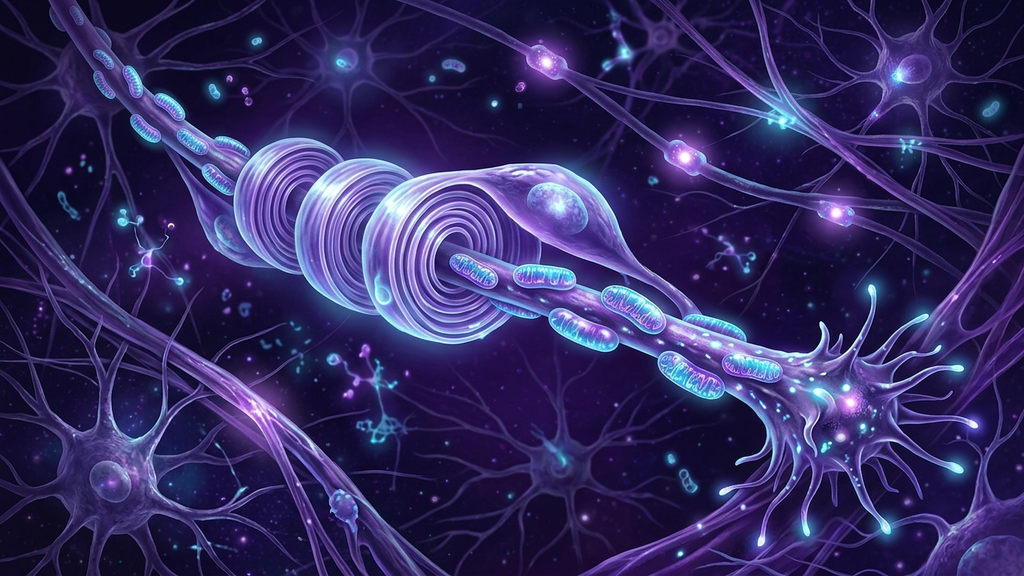
The degeneration story is only half of nerve biology. The other half is more hopeful and, remarkably, more relevant to the peripheral nervous system than the central one. Unlike the brain and spinal cord, peripheral nerves, the vagus among them, retain a genuine capacity to repair themselves. They can rebuild insulation and, under the right conditions, regrow. But repair is not a wish; it is a construction project with strict material requirements and a famously slow schedule. Understanding what the vagus needs to heal is the difference between hoping and helping.
Two Kinds of Repair
Recovery of a damaged nerve happens along two tracks, and they are not the same.
The faster track is remyelination (the rebuilding of the myelin insulation around an axon that is still intact). If the conducting fiber survived and only its sheath was stripped, the job is re-insulation, and it can restore fast, clean conduction relatively quickly. The slower track is regrowth of an axon that actually died back, a far longer undertaking.
The Cell That Does the Work
The hero of peripheral repair is the Schwann cell (the support cell that both insulates peripheral nerves and orchestrates their repair). After injury, Schwann cells do something the central nervous system's equivalents largely cannot: they switch into a dedicated repair state. They clear myelin debris, form guiding channels called bands of Bungner that steer the regrowing fiber, and then re-wrap the axon in new myelin. This repair-Schwann-cell program is the single biggest reason peripheral nerves outperform central ones at healing.
Schwann cells do not work alone. They depend on neurotrophic factors (signaling proteins that keep neurons alive and drive their regrowth), including brain-derived neurotrophic factor (BDNF) and nerve growth factor (NGF). These molecules are the growth signal; without adequate neurotrophic support, a regenerating axon stalls and a demyelinated one struggles to re-insulate.
The Timeline Nobody Can Rush
Here the numbers set honest expectations.
- Regenerating peripheral axons advance at roughly 1 mm per day, about an inch a month. This is the rule of thumb clinicians use, and it explains why nerve recovery is measured in months.
- Because the vagus is long, running from the brainstem the length of the trunk, even a modest gap implies a repair window of weeks to many months, not days.
- Remyelination of a surviving fiber is faster than full axonal regrowth, but still unfolds over weeks, not overnight.
- Repair is not guaranteed to be complete: the longer an axon has been denervated, the more the supporting environment degrades, so earlier repair conditions yield better outcomes.
Why Peripheral Beats Central
It is worth being precise about why the vagus has a repair option that a spinal cord injury largely does not. The difference is the supporting cell. In the peripheral nervous system, Schwann cells actively dismantle their own myelin after injury and reprogram into a growth-promoting state, laying down a permissive track for the axon to follow. In the central nervous system the equivalent cells, oligodendrocytes, do not switch into this repair mode, and the local environment actively inhibits regrowth. The vagus, for all its length and importance, is a peripheral nerve for most of its run, which places it on the more forgiving side of that divide. This single fact is the biological basis for cautious optimism about vagal recovery.
That optimism has limits worth naming. Even a perfectly staged repair can misroute: a regrowing fiber may reach the wrong destination, and remyelinated segments are often thinner than the original, so conduction can be restored without being fully normalized. Recovery is real, but it is rarely a clean return to baseline.
Mitochondria: The Non-Negotiable Prerequisite
Repair is metabolically expensive. Building myelin and extending an axon are among the most energy-demanding jobs a cell can undertake, and that energy comes from mitochondria (the organelles that generate the cell's usable energy). This is the quiet catch in the whole story: a nerve cannot rebuild what it cannot power.
If mitochondrial function is impaired, a feature of many post-viral and inflammatory states, the growth cone at the tip of a regenerating axon literally lacks the ATP to advance, and Schwann cells lack the fuel to remyelinate. This is why metabolic integrity is not a side issue for nerve repair; it is a precondition. A vagus with a good blueprint and no power supply will not heal on schedule.
What Helps and What Only Sounds Like It Helps
The mechanistic levers for repair are unglamorous but real: protect the surviving fibers from ongoing inflammatory injury, support the metabolic substrate so mitochondria can fund the work, and maintain neural activity, since a nerve that is used sends trophic signals that favor repair. Modalities that plausibly reduce local inflammation or improve tissue energetics act on this substrate; the honest framing is that they create conditions for repair rather than command repair directly. No intervention overrides the ~1 mm/day biology.
The Takeaway for Practitioners
The message to a patient with a structurally compromised vagus is neither false hope nor fatalism. It is this: the peripheral nervous system is genuinely built to repair, remyelination is a real and relatively rapid process, and the vagus is a peripheral nerve. But repair runs on a fixed clock and a real energy budget. The clinical job is to remove the obstacles, of inflammation, metabolic starvation, and ongoing compression, and then respect the timeline. Nerves heal slowly, but they do heal, and the conditions for that healing are largely within reach.
Reference: peripheral nerve regeneration and Schwann-cell repair literature, Journal of Neuroscience and related journals (2016-2023).