The Microbiome–Mitochondria Axis: Two Energy Systems, One Conversation
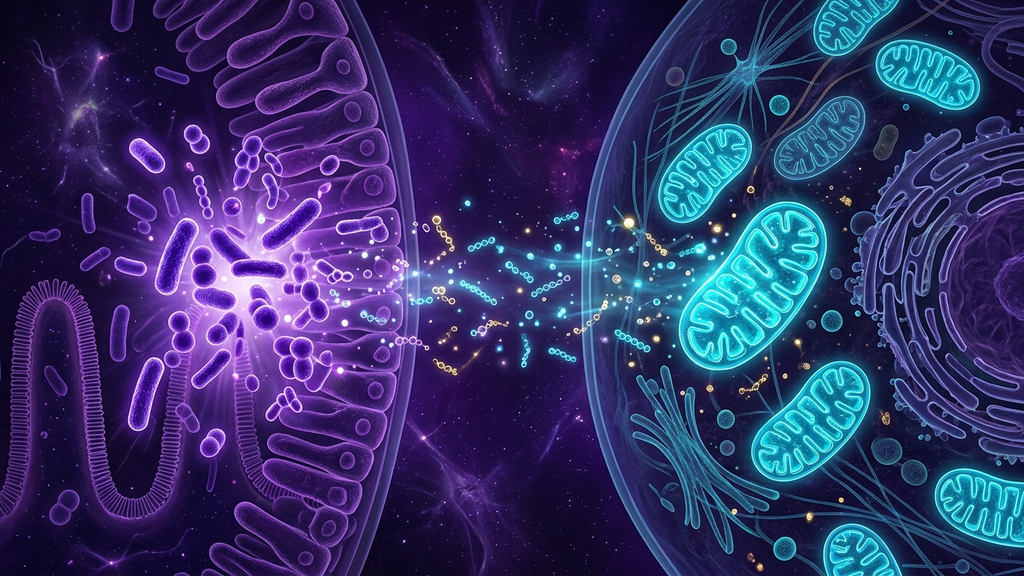
There is a story written in cellular biology that gets told too rarely. Roughly two billion years ago, a primitive eukaryotic cell engulfed a free-living bacterium and, instead of digesting it, struck a bargain. The bacterium would produce energy in the form of ATP. The host would provide protection and a steady supply of substrate. The bacterium became the mitochondrion. The host became every plant, animal, and human that has ever lived.
That ancient bacterial heritage has practical consequences. Mitochondria still have their own circular DNA. They still divide by binary fission. They still respond to bacterial signals as though they recognize them as kin. And the microbiome — the population of bacteria living inside your gut today — communicates with your mitochondria continuously, through a chemical vocabulary that both systems still understand.
What the Gut Bacteria Send
The gut microbiome produces a remarkable array of bioactive molecules that act on host mitochondria:
- Short-chain fatty acids (SCFAs) — butyrate, propionate, and acetate — produced by bacterial fermentation of dietary fiber. Butyrate is the preferred fuel for colonocytes and directly supports mitochondrial biogenesis throughout the body.
- Hydrogen sulfide (H₂S) at physiologic concentrations, which modulates the electron transport chain and acts as a signaling molecule.
- Trimethylamine and its metabolites, which can be pro- or anti-mitochondrial depending on concentration and host context.
- Vitamins — including B12, K2, biotin, and several other B-vitamins — produced by specific bacterial species and essential cofactors for mitochondrial function.
- Secondary bile acids, which modulate mitochondrial signaling in the liver and adipose tissue.
When the microbiome is diverse and well-fed, this output supports mitochondrial health throughout the body.
What Goes Wrong
A dysbiotic microbiome reverses the signal. Instead of supporting host mitochondria, it actively undermines them:
- Lipopolysaccharide (LPS) released from gram-negative bacterial cell walls leaks into circulation through an inflamed gut barrier. LPS directly inhibits mitochondrial complex I and triggers systemic inflammation. Chronically elevated LPS is associated with chronic fatigue, depression, and metabolic dysfunction.
- Loss of SCFA production starves the gut lining and reduces a key signal supporting mitochondrial biogenesis.
- Depletion of vitamin-producing species reduces cofactor availability.
- Microbial-derived toxins — including some mold and fungal byproducts in cases of small intestinal fungal overgrowth — can directly damage mitochondrial membranes.
The Clinical Picture
Dysbiosis-driven mitochondrial dysfunction often presents as a constellation that does not fit neatly into one specialty:
- Bloating, irregular bowels, food sensitivities
- Fatigue, brain fog, and exercise intolerance
- Low-grade inflammation with no clear source
- Skin issues — eczema, rosacea, persistent acne
- Mood instability, particularly anxiety with a digestive component
- Slow recovery from infections, including post-viral states
- Insulin resistance disproportionate to body weight
The Reset Protocol
1. Remove the Suppressors
If the system is dysbiotic, simply adding probiotics on top of an inflamed, irritated gut does not work. The first step is to reduce the load: identify and address food sensitivities, treat any underlying infections (H. pylori, SIBO, parasites where indicated), reduce alcohol, manage NSAIDs carefully, and clean up environmental exposures (mold, in particular, will keep the system locked in a dysbiotic-mitochondrial loop until it is addressed).
2. Feed the Right Bacteria
Fiber diversity matters more than fiber quantity. A wide range of plant foods — vegetables, fruits, legumes, nuts, seeds, whole grains where tolerated — feeds a broad bacterial population. Fermented foods (sauerkraut, kimchi, kefir, yogurt where dairy is tolerated) introduce live microorganisms and their metabolites. Polyphenol-rich foods (berries, dark chocolate, green tea, herbs and spices) selectively support SCFA-producing species.
3. Targeted Restoration
Specific probiotic strains have evidence behind them for specific applications: Lactobacillus rhamnosus GG for gut barrier function, Akkermansia muciniphila for metabolic health, Bifidobacterium longum for mood. Spore-based probiotics (Bacillus species) appear particularly useful for resetting dysbiotic patterns. Where evidence supports it, a more aggressive intervention — fecal microbiota transplantation — is becoming clinically available.
4. Support Mitochondrial Repair in Parallel
You cannot fix the conversation by only working on one side of it. While the microbiome recovers, the host's mitochondria need their cofactors: magnesium, CoQ10, B-complex, omega-3s, and where indicated, NAD+ precursors. PEMF and red/near-infrared photobiomodulation support mitochondrial recovery from the physical-medicine angle. Zone-2 exercise, when tolerated, drives mitochondrial biogenesis from the bottom up.
Where the Field Is Moving
The most interesting work happening at this interface is on precision microbiome therapeutics — designer probiotic consortia engineered to produce specific bacterial metabolites that target host mitochondrial function. Phase 2 trials are now reporting on engineered strains in metabolic disease and inflammatory bowel disease. The downstream goal is to be able to write a "mitochondria-supportive microbiome prescription" with the same precision we currently write a medication prescription.
Synthesis: Your gut bacteria and your mitochondria are evolutionary kin in continuous chemical dialogue. When that dialogue is healthy, energy flows. When it breaks down, energy fails everywhere downstream. Treat the conversation, not just either side of it.
References
- Saint-Georges-Chaumet Y, Edeas M. "Microbiota-mitochondria inter-talk: Consequence for microbiota-host interaction." Pathogens and Disease, 2016;74(1):ftv096.
- Donohoe DR et al. "The microbiome and butyrate regulate energy metabolism and autophagy in the mammalian colon." Cell Metabolism, 2011;13(5):517-526.
- Cani PD et al. "Metabolic endotoxemia initiates obesity and insulin resistance." Diabetes, 2007;56(7):1761-1772.
- Depommier C et al. "Supplementation with Akkermansia muciniphila in overweight and obese human volunteers." Nature Medicine, 2019;25(7):1096-1103.