Long COVID: A Mitochondrial and Vagal Recovery Framework
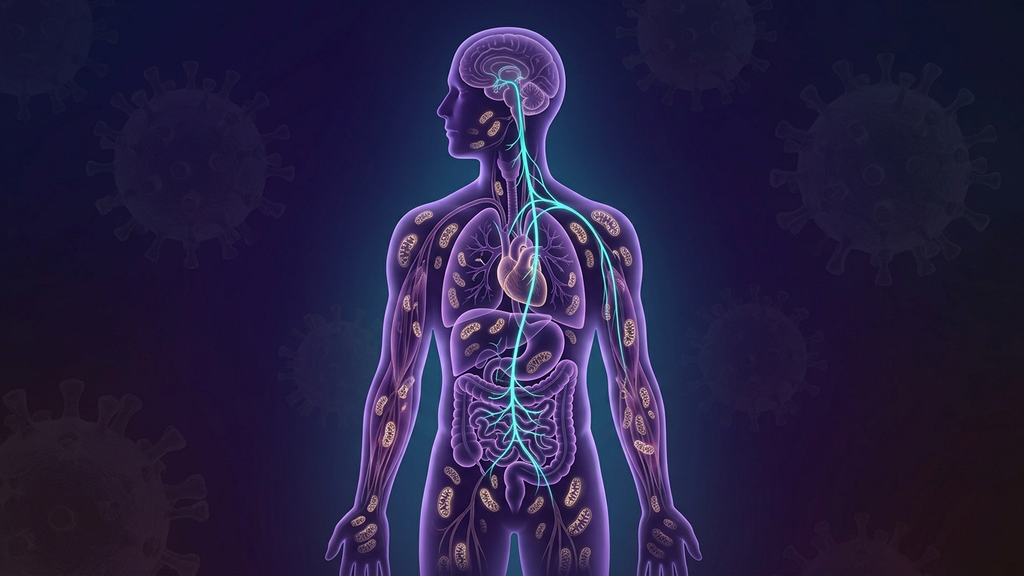
Long COVID was initially framed as a mystery. Four years of research later, it is no longer mysterious. The underlying biology is converging on a coherent picture: persistent neuroinflammation, microvascular injury, mitochondrial dysfunction, autonomic dysregulation, and — in many patients — reactivated latent viruses. The treatment framework follows directly from this biology.
The Five Mechanisms That Show Up in Almost Every Patient
- Mitochondrial dysfunction. Reduced complex I and IV activity, impaired ATP output, and elevated oxidative stress markers in both skeletal muscle and brain.
- Persistent neuroinflammation. Microglial priming, NLRP3 inflammasome activation, IL-6/TNF-α elevation. Drives brain fog, fatigue, sleep disruption.
- Microvascular injury. Microthrombi and endothelial dysfunction reduce tissue oxygen delivery — most visible as cerebral hypoperfusion on imaging.
- Autonomic dysregulation. POTS, inappropriate sinus tachycardia, low HRV, exaggerated catecholamine responses. The vagal brake has collapsed.
- Latent virus reactivation. EBV, HHV-6, and varicella reactivation are documented in a meaningful subset and contribute to ongoing immune activation.
What This Means for Recovery
You cannot exercise your way out of long COVID. Graded exercise therapy, applied without attention to post-exertional malaise, makes a significant subset of patients worse. The reason is mechanistic: if mitochondrial output is impaired and microvascular oxygen delivery is reduced, conventional exercise pushes the system into anaerobic deficit. The next-day crash is not deconditioning. It is a metabolic injury.
The Sequenced Recovery Framework
Phase 1 — Stabilize (weeks 0–8)
- Pacing. Stay below the symptom threshold. Heart-rate-guided pacing (typically keeping HR under ~110 or under 60% age-predicted max during ADLs) prevents post-exertional flares.
- Mitochondrial cofactors. CoQ10 (ubiquinol), magnesium glycinate, B-complex, alpha-lipoic acid. Restore the substrate availability for the ETC.
- Autonomic stabilization. Aggressive volume restoration (salt + fluids), compression garments, slow breathing twice daily.
- Sleep prioritization. Glymphatic clearance is the brain's primary anti-inflammatory mechanism.
Phase 2 — Reduce Inflammatory Load (weeks 4–16)
- Omega-3 EPA-dominant 2–3 g/day.
- Low-dose naltrexone for persistent microglial activation.
- Workup for reactivated EBV/HHV-6; treat when titers and clinical picture align.
- Address gut barrier dysfunction — leaky gut amplifies systemic inflammatory load.
Phase 3 — Rebuild Capacity (weeks 12+)
- Recumbent or seated movement first — minimizes orthostatic stress while rebuilding metabolic capacity.
- Gradual reintroduction of Zone-1 walking, guided by heart rate and next-day response, not perceived effort.
- Cognitive load management — brain fog responds to the same pacing principles as physical fatigue.
Where Bioelectronic Tools Fit
Several emerging tools intervene directly on the mechanisms above:
- Transcutaneous auricular vagus nerve stimulation — reduces systemic inflammation through the cholinergic anti-inflammatory pathway and restores parasympathetic tone.
- HRV biofeedback — measurable retraining of baroreflex sensitivity, useful in the autonomic recovery phase.
- Photobiomodulation (red and near-infrared) — early evidence for direct mitochondrial support via cytochrome c oxidase.
- Focused ultrasound — under investigation for selective vagal stimulation and neuromodulation.
The Markers That Tell You It Is Working
Recovery is non-linear. The first marker of progress is usually a higher HRV reading on rest mornings. Then a shorter recovery window after exertion. Then improvements in brain fog and cognitive endurance. Subjective energy is typically the last thing to lift, and it lifts unevenly.
Clinical takeaway: Long COVID is a mitochondrial, vascular, neuroinflammatory, and autonomic illness. Treat all four domains, pace aggressively, and the system rebuilds over months — not weeks. Patients who try to push through earn the crash.
References
- Davis HE et al. "Long COVID: major findings, mechanisms and recommendations." Nature Reviews Microbiology, 2023;21:133-146.
- Guo L et al. "The molecular mechanisms of cognitive dysfunction in long COVID: a narrative review." International Journal of Molecular Sciences, 2025;26(11):5102.
- Lyra E Silva NM et al. "Long-term neuropsychiatric COVID-19 and the role of microglia, mitochondria, and persistent neuroinflammation." Translational Psychiatry, 2021;11:355.
- Vernon SD et al. "Orthostatic intolerance in ME/CFS and long COVID." Frontiers in Medicine, 2022;9:917019.
- Klein J et al. "Distinguishing features of long COVID identified through immune profiling." Nature, 2023;623:139-148.