Insomnia and the Autonomic Nervous System: Why You Cannot Sleep When Your Vagus Cannot Brake
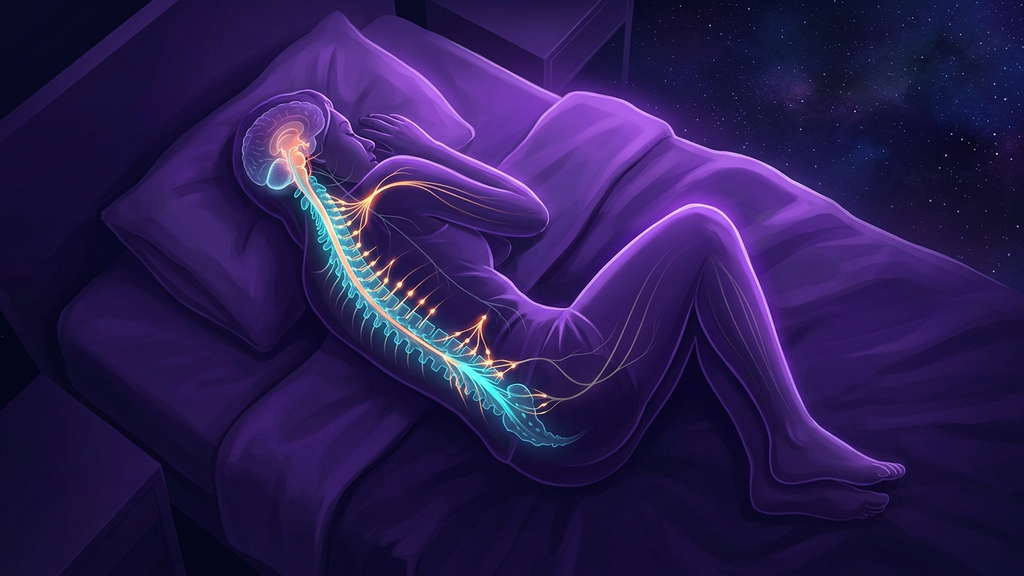
Patients with chronic insomnia almost universally describe the same paradox: exhausted but unable to fall asleep, or falling asleep only to wake at 3 a.m. wired and alert. The standard advice — sleep hygiene, melatonin, "stop scrolling at night" — fails because it does not address the underlying problem. Insomnia is not primarily a sleep disorder. It is a 24-hour autonomic dysregulation that becomes visible at night.
The HPA Axis Runs the Show
Cortisol is supposed to peak in the early morning and fall steadily through the day, reaching its nadir around midnight. In chronic insomnia, this curve is flat or inverted. Patients show a 24-hour increase in ACTH and cortisol secretion — peak elevations occur in the evening and the first half of the night. This is the biochemical definition of "tired and wired."
The Vagus Cannot Brake a Hyperaroused System
Sleep onset and depth depend on parasympathetic dominance. The vagus nerve is the brake pedal. When vagal tone is chronically low — measured indirectly by heart rate variability — the brake never fully engages. Sleep becomes shallow, fragmented, and unrefreshing even when total time in bed is high.
"Deep sleep has an inhibitory influence on the HPA axis, whereas activation of the HPA axis or administration of glucocorticoids can lead to arousal and sleeplessness. The loop runs in both directions, and breaking it requires intervening on the autonomic side."
What I Look For in the Workup
Sleep complaints get categorized too quickly. Before reaching for hypnotics or melatonin, I want to know:
- Salivary cortisol curve across four time points — flat or evening-elevated suggests HPA dysregulation.
- HRV trend over 7–14 days — chronic suppression confirms low parasympathetic reserve.
- Iron and ferritin — low ferritin is a common, under-recognized cause of fragmented sleep.
- OSA screen — even thin patients can have positional or REM-related apnea driving the arousal pattern.
- Magnesium and B6 — both are limiting cofactors for GABA synthesis.
The Sleep Protocol That Targets the Autonomic State
Daytime — set the stage
- Morning sunlight within 30 minutes of waking, 10–20 minutes outside.
- Caffeine cutoff by noon; alcohol disrupts the second half of the night even in modest doses.
- Zone-2 movement most days — improves baseline HRV and lowers evening sympathetic tone.
Evening — downshift the autonomic state
- Dim ambient light after sunset; eliminate overhead light 2 hours before bed.
- Last meal at least three hours before sleep — late eating elevates core temperature and shifts cortisol.
- Slow nasal breathing (6 breaths per minute) for 10 minutes — measurably increases HRV and reduces cortisol.
Night — engage the vagal brake
- Cool bedroom (16–18 °C).
- Magnesium glycinate 200–400 mg one hour before bed.
- HRV biofeedback or transcutaneous auricular vagus nerve stimulation in the wind-down window — shifts the autonomic balance toward parasympathetic dominance and supports sleep onset.
When Pharmacology Has a Role
Sleep medications are useful as bridges, not as long-term solutions. Z-drugs and benzodiazepines disrupt sleep architecture and create dependency. Trazodone and low-dose doxepin preserve architecture better and have a place in selected patients. For ruminative onset insomnia, addressing the autonomic state with CBT-I and HRV biofeedback outperforms drug therapy at one-year follow-up.
Clinical takeaway: Treat insomnia as an autonomic problem that is loudest at night. Restore vagal tone during the day, downshift the system at dusk, and the sleep will follow. Hypnotics that bypass the underlying state will eventually stop working.
References
- Vgontzas AN et al. "Chronic insomnia is associated with a shift of interleukin-6 and tumor necrosis factor secretion from nighttime to daytime." Metabolism, 2002;51(7):887-892.
- Hirotsu C et al. "Interactions between sleep, stress, and metabolism: From physiological to pathological conditions." Sleep Science, 2015;8(3):143-152.
- Cuberos-Paredes E et al. "Transcutaneous auricular vagus nerve stimulation inhibits mental stress-induced cortisol release." Physiological Reports, 2025;13(9):e70251.
- Lehrer P, Gevirtz R. "Heart rate variability biofeedback: how and why does it work?" Frontiers in Psychology, 2014;5:756.
- Buckley TM, Schatzberg AF. "On the interactions of the HPA axis and sleep: normal and aberrant patterns." Endotext, NCBI, 2020.